

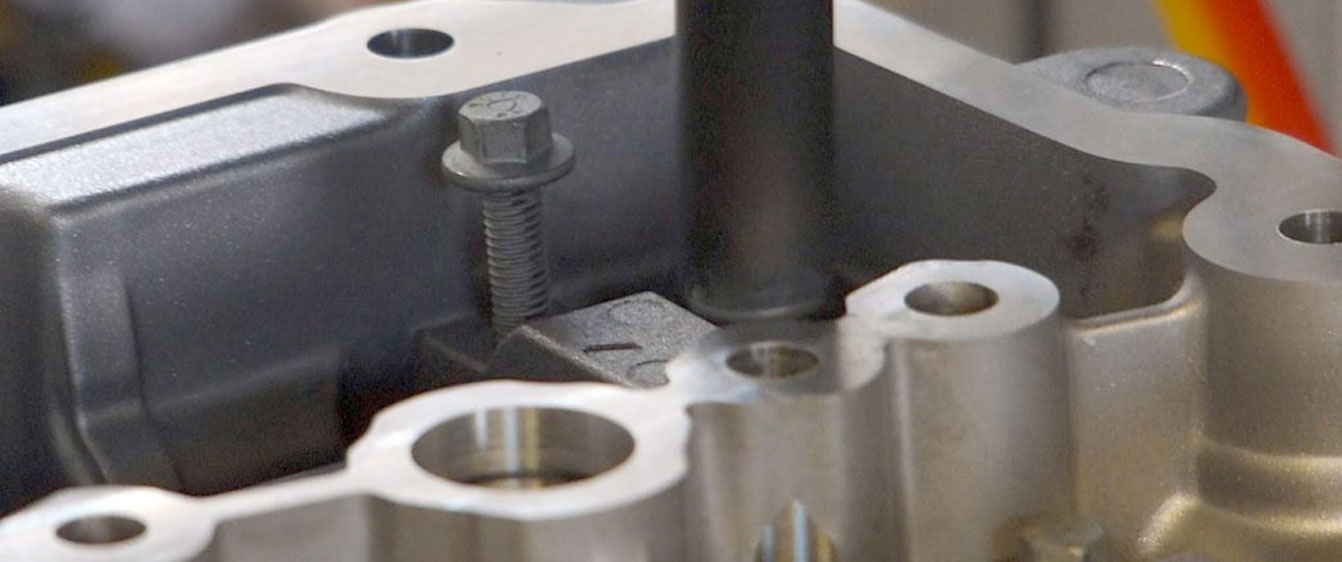
Automotive Casting Multi-Position Screwdriving & Marking System
Machine supplied: Automated screwdriving system for assembly / disassembly machine for cam carrier castings
Client: Leading Automotive Casting Company
Part: Cam Carrier Assembly
Operations: 20 Screws + 2 Dowel Pins + Multi-Position Marking
Modes: Production, Rework, and Teardown
The Challenge
A leading automotive casting company needed a flexible automated screwdriving system for cam carrier assemblies that could support three distinct operations:
- Low-volume production assembly (20 self-tapping screws, 2 dowel pins, identification marking)
- Rework of partially assembled or defective units (selective screw removal and replacement)
- Complete teardown for reprocessing (removal of all 20 screws)
The cam carrier assembly consists of a single casting with 9 cam caps secured by 20 Taptight self-tapping screws plus 2 hollow dowel pins. Each assembly requires unique identification marking so that if disassembled, components can be reassembled in their original matched configuration.
Manual assembly and teardown were time-consuming and risked damaging expensive castings through inconsistent screw torque or improper cam cap positioning. The system needed to handle multiple operational modes without tooling changes.
The Solution
TQC designed a multi-position screwdriving and marking system using dual 2-axis servo positioning to access all 20 screw locations plus multiple marking positions. The system integrates electronic screwdrivers, pin insertion mechanisms, vision inspection, and dot peen marking in a single platform that operates in production, rework, or teardown modes as selected by the operator.
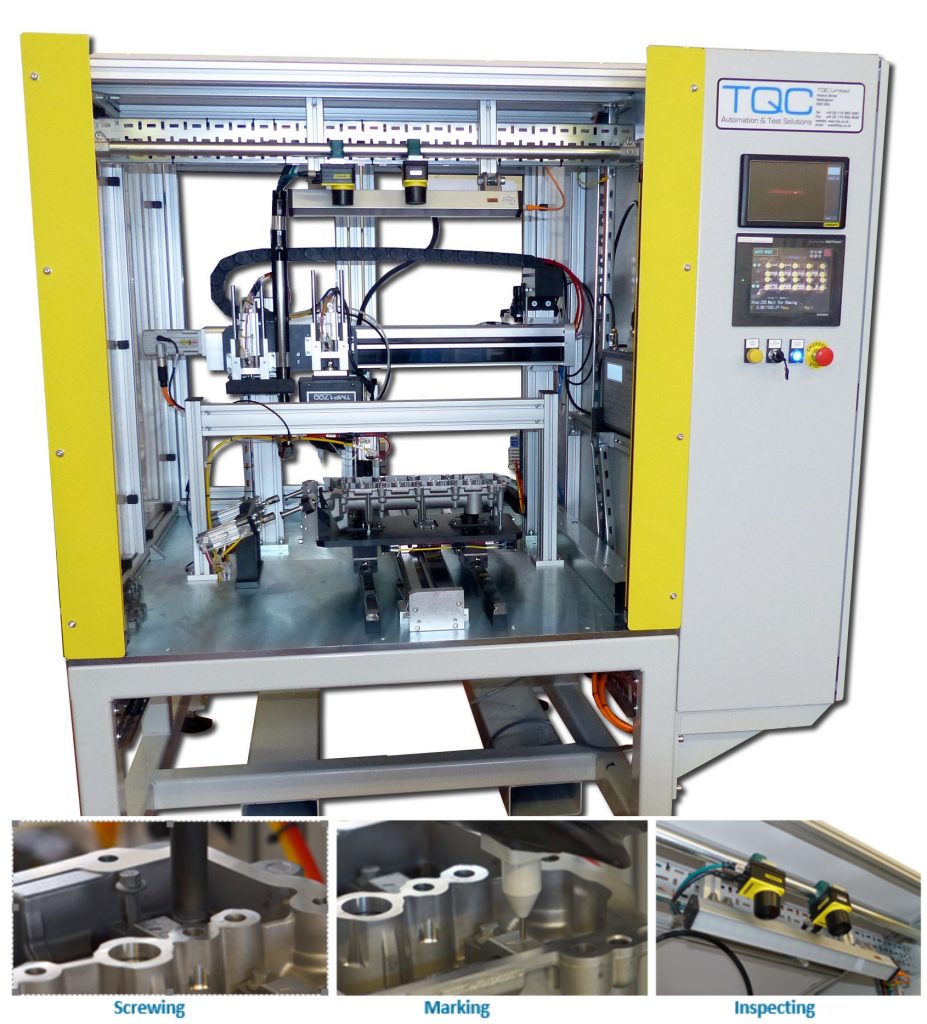
Technical Overview of this Automated Screwdriving System
Machine Architecture
Base Structure: Fabricated mild steel frame with steel bedplate provides rigid platform for servo positioning systems. The heavy base minimizes vibration during screwdriving operations.
Upper Guarding: Aluminium extrusion framework with polycarbonate panels provides operator visibility while maintaining safety compliance. Interlocked access doors prevent operation when open.
Platen System: The machine platen holds the casting and cam caps and indexes to different stations for pin insertion, screwdriving, and marking operations.
Dual 2-Axis Servo Positioning
The system uses two independent 2-axis servo systems to position screwdrivers and markers across all required locations:
Axis Configuration:
- Machine platen moves in X-axis (front to back)
- Screwdriver/marker tools move in Y-axis (left to right)
- Combined motion provides access to all 20 screw positions and marking locations
Servo Control: Programmable positioning allows precise tool placement for each screw location. Position data is stored for all 20 screw sites plus marking positions, ensuring repeatable tool alignment.
Speed and Accuracy: Servo drives provide rapid indexing between positions while maintaining positional accuracy required for self-tapping screw engagement and marking placement.
Electronic Automated Screwdriving System
Screwdriver Type: Electronic screwdrivers with torque and angle monitoring. The system detects when screws are properly seated and torqued.
Taptight Screws: The assembly uses Taptight self-tapping screws that cut threads into the casting as they’re driven. Electronic screwdrivers provide controlled torque to prevent stripping threads or over-tightening.
Screw Feeding: Automatic screw presentation to the driver bit eliminates manual screw handling. The feeder queues screws for sequential insertion.
Torque Verification: Each screw installation is monitored for proper torque. Out-of-spec results trigger alarms and prevent progression to the next screw.
Position Sequencing: The system follows a programmed sequence through all 20 screw positions, automatically moving the platen and screwdriver to each location.
Pin Insertion Mechanisms
Two hollow dowel pins are automatically inserted into the casting:
Pin Feeding: Pins are fed from bulk storage to insertion mechanisms. Sensors verify pin presence before insertion attempt.
Insertion Process: Pneumatic or servo-driven insertion rams press pins into casting bores. Force monitoring detects improper insertion or missing pins.
Pin Verification: Vision inspection confirms both pins are fully seated and properly oriented after insertion.
Vision Inspection Systems
Two vision systems perform inspection at different stages:
Initial Vision Inspection (Load Station):
- Verifies main casting is correctly positioned on platen
- Checks that all 9 cam caps are present
- Confirms cap orientation and placement
- Prevents assembly attempt if parts are missing or incorrectly loaded
Final Vision Inspection (Unload Station):
- Inspects completed assembly for proper screw installation
- Reads dot peen identification marks to verify marking quality
- Checks for damaged threads or casting defects
- Provides pass/fail determination
Lighting Systems: Each vision station includes optimized lighting to enhance part features and marking contrast for reliable inspection.
Dot Peen Marking
Marking System: Electromagnetic dot peen marker creates permanent identification marks on the casting and cam caps.
Multi-Position Marking: The dual servo system positions the marking head at multiple locations to mark:
- Assembly serial number
- Cap position identifiers (so caps can be reinstalled in matched positions)
- Date code or production shift information
Mark Verification: The final vision inspection reads the peen marks using OCR (optical character recognition) to verify mark quality and data accuracy.
Permanent Marking: Dot peen creates deformation marks that cannot wear off or be removed, providing permanent traceability for the assembly’s lifetime.
Operational Modes of this Automated Screwdriving System
The system operates in three distinct modes selected by the operator:
Production Mode (New Assembly)
Complete assembly process for new cam carrier:
1. Manual Load: Operator places casting and 9 cam caps on machine platen at front station.
2. Vision Verification: System confirms all parts present and correctly positioned. Rejects proceed if parts missing or misaligned.
3. Pin Insertion Station: Platen indexes to pin insertion station. System inserts 2 hollow dowel pins with force monitoring.
4. Screwdriving Station: Platen indexes to main assembly position. Screwdrivers install all 20 Taptight screws sequentially using the dual 2-axis servo positioning. Each screw is torque-verified.
5. Marking Station: Dot peen marker creates identification marks at multiple positions on casting and cam caps. Servo positioning places marking head accurately.
6. Final Inspection: Platen returns to front position. Vision system inspects assembly completeness and reads identification marks using OCR.
7. Manual Unload: Operator removes completed assembly if passed, or addresses reject if failed.
Rework Mode (Partial Teardown/Reassembly)
Selective screw removal and replacement for rework:
Operator Selection: Operator specifies which screws need removal/replacement via HMI touchscreen.
Selective Removal: System removes only specified screws using electronic screwdrivers in reverse. Screws are collected in reject bin.
Reassembly: System installs new screws in the reworked positions with torque verification.
Marking Update: Identification marks are updated to reflect rework (rework date, revision code).
Final Inspection: Vision verifies reworked assembly and updated marking.
Use Cases: Damaged screws, stripped threads, incorrect torque, cam cap repositioning.
Teardown Mode (Complete Disassembly)
Full screw removal for casting reprocessing:
Complete Removal: System removes all 20 screws in reverse sequence. Electronic screwdrivers extract screws without damaging casting threads.
Screw Collection: Removed screws collected for inspection or disposal.
Casting Recovery: Casting and cam caps are returned to operator for cleaning, inspection, or rework before potential reassembly.
Use Cases: Defective castings requiring rework, assemblies returned from customers, process validation failures.
Control System for the Automated Screwdriving System
PLC Control: Programmable logic controller manages all automation sequences, servo positioning, vision systems, and operator interface.
HMI Touchscreen: Operator interface for mode selection (production, rework, teardown), program selection for different cam carrier variants, and real-time status display.
Data Logging: System records all screw torques, pin insertion forces, vision inspection results, and marking data for quality traceability.
Error Handling: Automatic fault detection with operator guidance for recovery. System identifies which screw or operation failed and provides troubleshooting information.
System Specifications – Automated Screwdriving System
- Assembly Operations: 20 screws + 2 dowel pins + multi-position marking
- Positioning: Dual 2-axis servo systems (platen X-axis, tool Y-axis)
- Screwdriving: Electronic drivers with torque and angle monitoring
- Screw Type: Taptight self-tapping (thread-cutting)
- Pin Insertion: Pneumatic/servo with force monitoring
- Vision Systems: 2 (load verification and final inspection with OCR)
- Marking: Electromagnetic dot peen, multiple positions
- Operational Modes: Production, rework (selective), teardown (complete)
- Frame: Fabricated mild steel with steel bedplate
- Guarding: Aluminium extrusion with polycarbonate panels
- Control: PLC with HMI touchscreen
- Loading: Manual load/unload
- Application: Automotive cam carrier castings
Key Features – Automated Screwdriving System
Multi-Mode Flexibility: Single system handles production, selective rework, and complete teardown without tooling changes.
Dual Servo Positioning: Two 2-axis systems provide access to all 20 screw positions plus marking locations.
Electronic Screwdriving: Torque and angle monitoring ensures consistent Taptight screw installation.
Vision Verification: Inspection at load and unload stations confirms part presence, assembly quality, and marking legibility.
Permanent Identification: Dot peen marking provides lifetime traceability with matched component positions.
Self-Tapping Screws: Electronic control prevents thread damage during Taptight screw installation and removal.
Selective Rework Capability: Operator-specified screw removal and replacement without full teardown.
Results
The multi-position screwdriving and marking system provides flexible automation for cam carrier assemblies. The three operational modes (production, rework, teardown) eliminate the need for separate equipment for each operation.
Electronic screwdriving with torque monitoring ensures consistent Taptight screw installation that prevents thread damage or over-torque failures. Vision inspection at load and unload stages catches assembly errors before they progress, reducing scrap.
Dot peen marking with multi-position identification enables matched component reassembly if disassembly becomes necessary. The permanent marks survive the engine’s operating life.
Following successful implementation, the customer ordered two additional machines: one fully automated version for high-volume production, and one specialized system for high-performance sports car engines.
To view a printer friendly format please click below
Casting Screwdriving and Marking System
Related Capabilities
This project demonstrates TQC‘s expertise in:
- Multi-position servo positioning systems
- Electronic screwdriving with torque monitoring
- Dot peen marking systems
- Vision inspection and OCR
- Multi-mode automation (production/rework/teardown)
- Self-tapping screw installation
- Automotive casting assembly
- Pin insertion with force monitoring
- Traceability and identification marking
- PLC control with operator interface
If you need multi-position screwdriving, marking systems, or flexible assembly automation with rework capability, contact TQC to discuss your requirements