

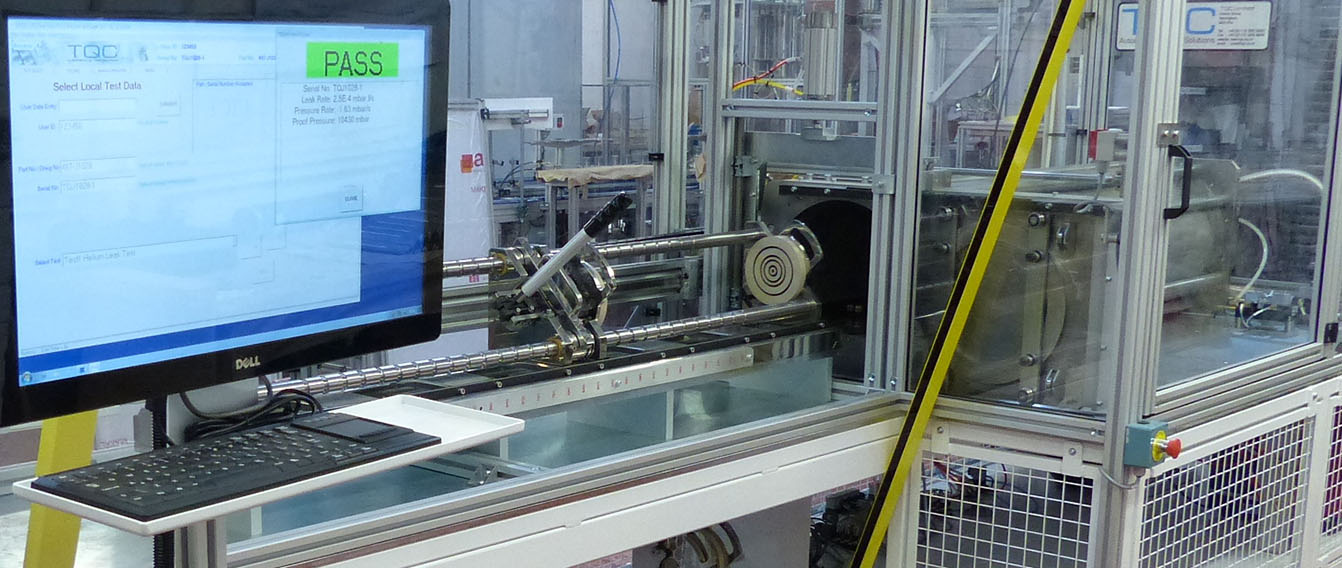
Fuel Pipe Helium Leak Test System
Machine supplied: Fuel Pipe Helium leak test system
Client: Leading Global Aerospace Technology Company
Part: Composite Fuel Pipes for the Aerospace Sector
Throughput: 15 parts per hour
Test Methods: High-Pressure Proof Test (210 bar) + Helium Mass Spectrometry
The Challenge
A leading global aerospace technology company needed production acceptance testing for composite fuel pipes across multiple part variants with different diameters and lengths. The test requirements included:
- High-pressure proof testing to 210 bar to verify structural integrity
- Helium leak detection to aerospace sensitivity levels (typically 1×10⁻⁹ mbar·l/s)
- Part traceability with RFID and barcode data integration
- Throughput of 15 parts per hour across multiple variants
- Automated testing to eliminate operator variability
Composite fuel pipes require both pressure testing (to confirm they can withstand operating pressures) and helium leak testing (to detect minute leak paths that could allow fuel vapour escape or contamination ingress).
The Solution – Fuel Pipe Helium Leak Test
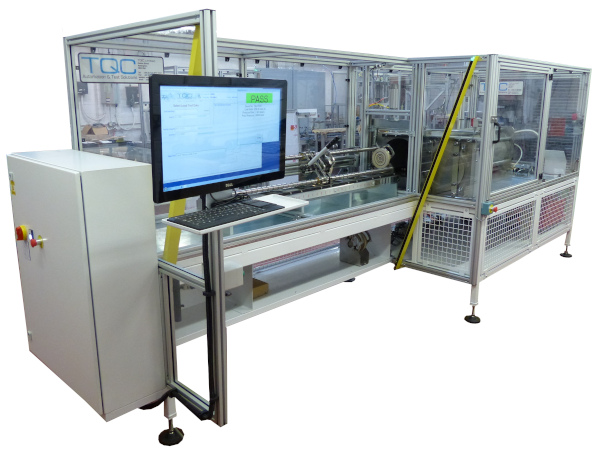
TQC designed and built a dual-test system combining high-pressure proof testing with helium mass spectrometry leak detection. The system uses a drawer-style test chamber with automated sequencing that performs pressure testing first, followed by helium leak detection on passed parts. Multi-variant tooling accommodates different pipe configurations without changeover delays.
Technical Overview – Fuel Pipe Helium Leak Test
System Architecture
The fixture is based on TQC‘s Series 20 drawer concept, adapted for high-pressure testing and helium leak detection. The drawer mechanism allows safe loading and unloading outside the test chamber while providing automated transfer into the sealed test environment.
Load/Unload Station: The operator positions the fuel pipe in the tooling and secures two end clamp units that seal the pipe ends and provide pressure/helium supply connections.
Automated Carriage: A powered carriage moves the loaded tooling from the load/unload position into the test chamber. This automated transfer eliminates manual handling near the high-pressure test area.
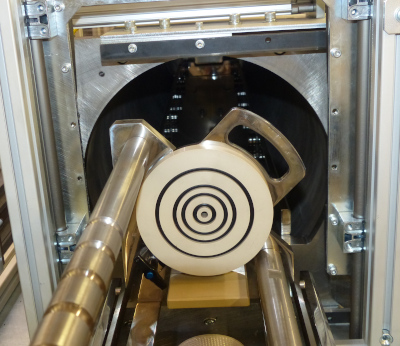
Test Chamber with Automated Door: The test chamber closes and seals automatically once the tooling is positioned. The chamber isolates the test from ambient conditions and contains helium during leak testing.
Multi-Variant Tooling
The tooling system accommodates different pipe diameters and lengths through adjustable end clamps and flexible positioning:
End Clamp Units: Each clamp seals the pipe end, provides pressure connection, and allows helium fill. The clamps adjust to different pipe diameters within the variant range.
Variable Length Accommodation: The tooling positions pipes of different lengths within the test chamber while maintaining proper sealing and pressure connections.
Quick Changeover: Variant changes require only adjustment of the end clamps, not complete tooling replacement, enabling efficient production of mixed part runs.
Test Sequence
The system performs two sequential tests automatically:
1. High-Pressure Proof Test (up to 210 bar)
Purpose: Verify the structural integrity of the composite pipe and confirm it can withstand operating pressures without failure.
Method:
- Pipe is filled with hydraulic fluid or high-pressure air
- Pressure is increased to the specified proof pressure (up to 210 bar)
- Pressure is held for a defined dwell time
- System monitors for pressure drop that would indicate structural failure
- If proof test fails, the part is rejected and helium test is bypassed
Why This Comes First: Proof testing eliminates gross failures before the time-consuming helium leak test. A pipe that fails proof test would also fail leak testing, so performing proof test first saves time.
2. Helium Mass Spectrometry Leak Test
Purpose: Detect minute leak paths (permeation, porosity, seal defects) that could allow fuel vapour escape or contaminant ingress.
Method:
- Test chamber is evacuated to high vacuum (typically <10⁻⁴ mbar)
- Pipe interior is filled with helium tracer gas
- Mass spectrometer continuously monitors the chamber vacuum for helium molecules
- Any helium escaping from the pipe is detected and quantified
- Leak rate is compared to acceptance criteria (typically 1×10⁻⁹ mbar·l/s for aerospace fuel systems)
Advantages of Helium Mass Spectrometry:
- Sensitivity: Detects leaks 1000× smaller than pressure decay methods
- Speed: Test completes in seconds once vacuum is established
- Quantitative: Provides actual leak rate measurement, not just pass/fail
- Helium Efficiency: High vacuum method uses minimal tracer gas compared to accumulation techniques
- No Contamination: Helium is inert and leaves no residue
Control and Data Management
PC-Based Control System: A dedicated PC controls all test sequencing, pressure regulation, vacuum control, and data acquisition. The interface provides:
- Circuit mimic display showing system status in real time
- Test parameter setup for different part variants
- Live pressure and leak rate monitoring
- Pass/fail determination and result logging
Traceability Integration: The system uses RFID readers and barcode scanners to:
- Identify parts at load station
- Link test results to specific serial numbers
- Prevent testing of unauthorised parts
- Enable automated data export to customer quality systems
Safety Interlocks: Light guards at the load/unload station and chamber door interlocks prevent operator access during high-pressure testing and chamber evacuation.
System Specifications – Fuel Pipe Helium Leak Test
- Test Chamber: Drawer-style with automated door and sealing
- Proof Test Pressure: Up to 210 bar
- Proof Test Medium: Hydraulic fluid or high-pressure air
- Leak Test Method: Helium mass spectrometry (high vacuum)
- Vacuum Level: <10⁻⁴ mbar (typical)
- Leak Detection Sensitivity: 1×10⁻⁹ mbar·l/s
- Tracer Gas: Helium (inert, low viscosity)
- Throughput: 15 parts per hour (including load, test, unload)
- Tooling: Multi-variant with adjustable end clamps
- Carriage Travel: Automated transfer between load and test positions
- Traceability: RFID and barcode integration
- Control: PC-based with circuit mimic display
- Operator Interface: Floor-standing fixture with light guard protection
- Part Variants: Multiple diameters and lengths without tooling change
Key Features – Fuel Pipe Helium Leak Test
Sequential Testing: Proof test eliminates gross failures before helium test, optimizing cycle time.
High-Pressure Capability: 210 bar proof testing verifies structural integrity for high-pressure fuel systems.
Helium Mass Spectrometry: Provides aerospace-grade leak detection sensitivity with fast test times.
Multi-Variant Tooling: Accommodates different pipe configurations with minimal changeover.
Automated Operation: Carriage transfer and door closing eliminate operator variability and improve safety.
Full Traceability: RFID and barcode integration links results to serial numbers for aerospace quality requirements.
Helium Efficiency: High vacuum method minimises tracer gas consumption compared to accumulation techniques.
Results
The combined proof test and helium leak test system provides complete production acceptance testing for aerospace composite fuel pipes at the required throughput of 15 parts per hour. Sequential testing (proof test first, then helium test) optimises cycle time by rejecting structural failures before performing the sensitive helium test.
Helium mass spectrometry achieves the sensitivity required for aerospace fuel system components while maintaining production throughput. The multi-variant tooling enables efficient testing of mixed production runs without changeover delays.
Full traceability integration ensures test results are linked to part serial numbers, meeting aerospace quality documentation requirements.
Related Capabilities
This project demonstrates TQC‘s expertise in:
- Helium mass spectrometry leak testing
- High-pressure proof testing (up to 210 bar)
- Sequential test system design (structural + leak testing)
- Drawer-style test chambers with automation
- Multi-variant tooling for flexible production
- RFID and barcode traceability integration
- Aerospace and defense industry quality standards
- Composite component testing
- PC-based control and data acquisition
TQC has in the past also provided helium leak test solutions for other parts, for example, fuel tanks, automotive suspension parts, and gas fittings
To view a printer friendly format please click below
Fuel Pipe Helium Leak Test System
If you need high-pressure proof testing combined with helium leak detection for aerospace or automotive components, contact TQC to discuss your application.