

Pick and Place Robot: Which Robot Type Suits Your Application?
Choosing a pick and place robot is not simply a case of selecting the fastest or most advanced model. Payload, reach, cycle time, movement, part orientation, floor space and operator access all influence which robot architecture is appropriate.
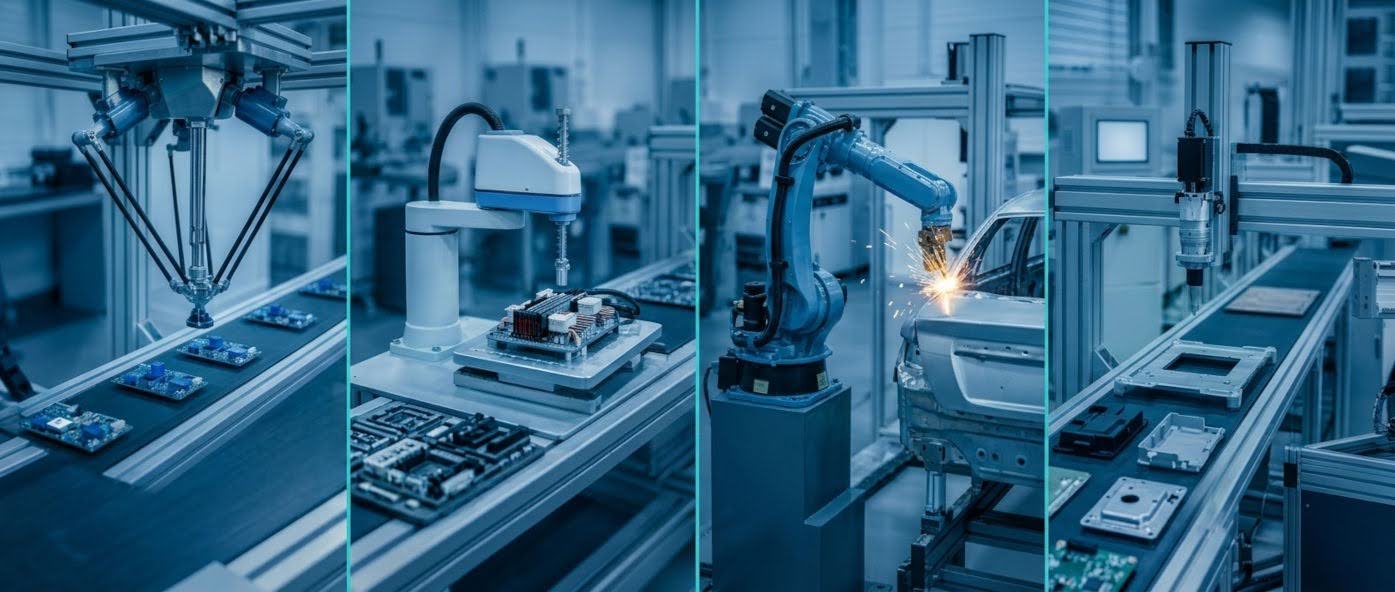
Articulated arms, SCARA robots, Cartesian systems, delta robots and collaborative robots each have different strengths. Matching the robot to the handling task early helps avoid unnecessary cost, complexity or performance compromises later in the machine design.
Start with payload, reach and movement
The payload must include the part and the end-of-arm tooling, not just the component being moved. A gripper, brackets, sensors and service connections all add weight and can reduce the speed or reach available from the robot.
The work envelope also matters. Define every position the robot needs to reach, including pick, place, inspection and any intermediate clearance points. Then establish whether the part needs to change orientation during the move or simply travel between two fixed positions.
When an articulated robot is a good fit
A multi-axis articulated arm provides the greatest freedom of movement. It can approach from different angles, reorient parts and work around obstacles, making it useful for complex handling, machine tending and assembly tasks.
That flexibility can be unnecessary for a simple planar transfer. If the application only needs a short, fast pick-and-place movement, a simpler architecture may deliver better performance for less complexity. TQC’s multi-axis robot integration is therefore specified where the motion genuinely needs the additional axes.
When to consider a SCARA robot
A SCARA robot is fast and accurate for movements mainly in the horizontal plane, with a vertical axis for lifting, placing or insertion. This makes it well suited to component handling, assembly and repetitive pick-and-place where the work area is compact.
The limitation is orientation freedom. A SCARA cannot manipulate a part through the same range of angles as a six-axis arm. Where the task fits its work envelope, however, it can be a very efficient choice.
When a delta robot makes sense
A delta robot is designed for very high-speed movement of relatively light parts over a short working area. The motors remain on the fixed structure, keeping the moving mass low and allowing rapid acceleration.
This suits fast sorting, picking from conveyors and packaging-style transfers. A delta robot is less suitable for heavy payloads, large work envelopes or tasks that need complex part reorientation. Its speed advantage should solve a real cycle-time problem rather than being specified for its own sake.
Cartesian and collaborative robots have different strengths
Cartesian or gantry systems move on linear X, Y and Z axes. They are straightforward to program, can cover long travel distances and can be designed for substantial payloads. They work best where the task follows a predictable rectangular work envelope and does not require complex wrist motion.
Collaborative robots are usually articulated arms with additional safety functions designed for applications where people and robots need to share a workspace. Their value is access and flexibility, but safe collaborative operation can limit speed and force. In a fully guarded high-speed cell, a traditional industrial robot may be more appropriate.
The gripper is part of the robot selection
A pick and place robot is only effective if the end-of-arm tooling can hold the part reliably. Vacuum cups suit smooth, non-porous surfaces, mechanical grippers suit rigid components, and specialist tooling may be needed for delicate, porous or irregular products.
Grip force, acceleration, surface condition, part variation and service routing should be considered at the same time as the robot payload. Treating the gripper as an afterthought can result in dropped parts or an underspecified robot.
Choose the architecture from the application
For short, fast planar moves, consider SCARA. For very high-speed lightweight picking, consider delta. For complex three-dimensional movement, an articulated arm is often stronger. For long linear travel or heavy loads, Cartesian can be effective. Collaborative robots suit applications where shared access provides a genuine benefit.
TQC designs pick and place robotic systems around the required payload, cycle time, reach and process rather than a preference for one robot brand or architecture.
Discuss your robotic handling application with TQC
If you are comparing robot types for a new handling or assembly process, TQC can assess the movement, tooling, guarding and integration requirements before the design is fixed. Find out more about our pick and place robot systems and contact the engineering team to discuss your application.