

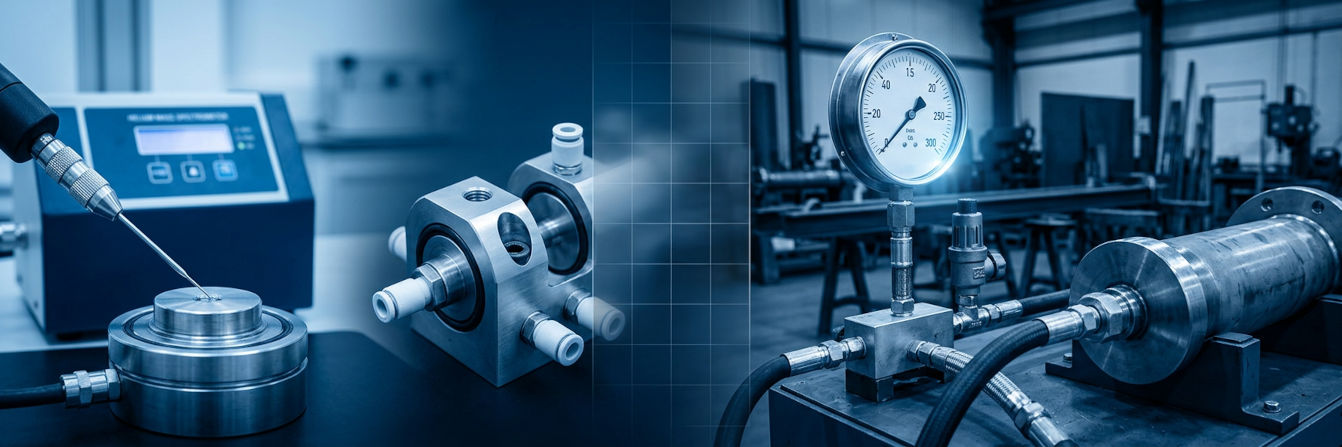
Leak Testing Equipment vs Pressure Testing Machine
Leak testing measures how much gas or fluid escapes from a component under defined conditions, while pressure testing checks whether the component can withstand a specified pressure without failure. They answer different questions, which is why passing a pressure test does not automatically mean a part will pass a leak test.
How Does Leak Testing Equipment Measure Leak Rate?
A leak test measures the rate at which fluid or gas escapes through a part under defined conditions — pressure, medium, sometimes temperature. The result is a quantified leak rate, typically in mbar·l/s or sccm, compared against a rejection threshold to give pass or fail.
Common production methods include pressure decay (measuring pressure drop after isolation), mass flow testing, and tracer gas methods using helium, which can detect leaks several orders of magnitude smaller than air-based methods. Leak testing is typically a 100% production test, confirming the integrity of each individual assembly, not the design.
Leak testing is the right requirement when:
- The product must not leak fluid or gas beyond a defined rate
- There’s a specific leak rate limit in mbar·l/s, sccm or equivalent
- Small leaks could affect performance, safety or compliance over time
- The test needs to run on 100% of production
Examples: automotive fuel/coolant systems, HVAC refrigerant circuits, medical fluid paths, sealed electronics
How Does A Pressure Machine Prove Structural Integrity?
A pressure test asks a different question: can the part safely withstand the applied pressure without failure? The part is pressurised — typically to a multiple of its working pressure — and held for a set duration, checked for visible leakage, deformation or catastrophic failure. A hydrostatic test under the Pressure Equipment Directive is commonly run at 1.43× the maximum allowable working pressure.
Water is the preferred medium wherever catastrophic failure is a risk, since it’s incompressible and releases stored energy slowly if a part fails. Pneumatic testing is used where water can’t be introduced, but requires extra safety precautions.
Pressure testing is the right requirement when:
- You need to demonstrate a safety margin against a defined pressure
- The applicable standard (PED, ASME, BS EN, PSSR) specifies a hydrostatic or pneumatic proof test
- The part is a pressure vessel, pipework system, or pressure-retaining assembly
- It’s a one-time or periodic certification check
Examples: pressure vessels, industrial pipework, boiler systems, hydraulic accumulators
Side-by-side comparison
| Factor | Leak testing | Pressure testing |
|---|---|---|
| Question answered | How much is leaking? | Can it withstand test pressure? |
| Result | A measured leak rate | Pass/fail observation |
| Units | mbar·l/s, sccm | bar, psi, kPa |
| Test pressure | At/near working pressure | 1.25–1.5× working pressure or higher |
| Medium | Air, nitrogen, helium/tracer gas | Water (hydrostatic) or air (pneumatic) |
| Sensitivity | High | Low to moderate — visible leaks only |
| Typical standards | Application/customer-specific | BS EN 13480, ASME, PED, PSSR 2000 |
| Production use | Often 100% automated test | Often one-time/periodic certification |
Why A Pressure Test Pass Doesn’t Confirm A Leak Test Pass
This is the most important and most misunderstood point. A part can hold 1.5× its working pressure for ten minutes with no visible failure, and still fail a production leak test. A hairline crack or minor seal defect can comfortably hold proof pressure while still leaking above an acceptable rate. The reverse is also true: a part meeting a tight leak rate hasn’t been proof-pressure tested, so its structural margin above working pressure is unknown.
When Both Tests Are Required
Many applications need both, because they answer different questions. A hydraulic valve block needs a hydrostatic test to confirm it won’t fail structurally, and a leak test to catch cross-port leakage that a pressure test wouldn’t reveal. Medical device fluid paths often need container closure integrity testing to a tight leak rate (sometimes under 10⁻⁴ mbar·l/s) alongside pressure validation during development. Gas pressure vessels need a statutory hydrostatic proof test as well as in-service leak checks on connections and seals.
Specifying The Right Test
For a leak test, specify the maximum acceptable leak rate and units, test pressure, medium, temperature (if relevant), and preferred method. For a pressure test, specify the test pressure and its relation to working pressure, medium, hold duration, acceptance criteria, and the applicable standard.
TQC provides contract leak testing across pressure decay, mass flow, vacuum decay, and helium tracer gas methods, and designs leak testing equipment for integration into production lines. Where a customer describes what they need to confirm about their part rather than a specific test method, our engineers advise on whether leak testing, pressure testing, or both is the right approach.
Not sure whether you need a leak test, a pressure test, or both? Contact TQC’s engineering team to discuss your application.
Need Help Choosing The Right Leak Testing Equipment For Your Production Process?
TQC designs leak test equipment for end of line testing, from industrial leak testing equipment through to bespoke test automation built around your component, leak rate and cycle-time requirements. Contact TQC’s engineering team to discuss the most appropriate test method and solution for your application.