

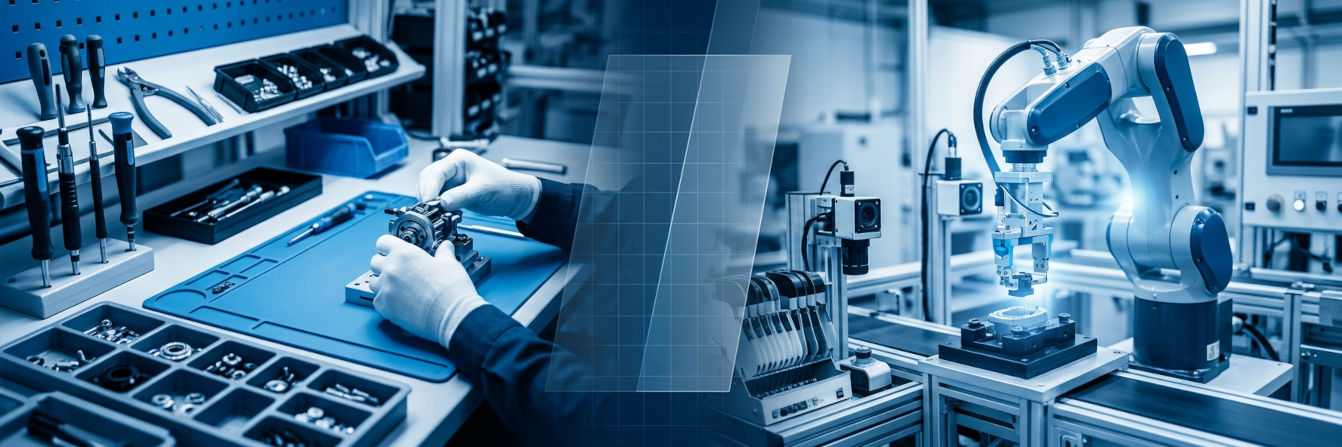
Manual vs Automatic Assembly: When to Choose Automated Assembly Systems
Manual assembly is generally better suited to lower-volume, changeable or judgement-heavy processes. Automated assembly systems are usually a stronger fit when the process is stable and production volumes, takt time, quality requirements and labour savings justify the investment.
The Question Every Production Engineer Faces
At some point in most manufacturing programmes, the question arises: should this process be manual or automated? The right answer depends on production volume, product complexity, quality requirements, capital availability, and how stable the process is. This guide sets out the trade-offs so the decision can be made on the factors that actually matter for your application.
Capital Expenditure And Labour Cost
The financial case for automation comes down to a single trade-off: a higher upfront capital cost in exchange for lower ongoing labour costs.
Manual assembly has a low capital threshold. Equipment is simpler, tooling is less complex, and there is no machine build programme to manage. This is a genuine advantage for low-volume production or products likely to change, since the capital isn’t at risk if the product is modified or discontinued.
Automated assembly systems require a higher fixed investment covering design, procurement, manufacture and commissioning. This is recovered through the payback period, once labour savings offset that cost. It works best where volumes and labour rates are high, and can take much longer to pay back where they’re not.
Maintenance costs run in the opposite direction. Manual assembly needs minimal upkeep, while automated systems require ongoing investment in planned maintenance, spares and engineering support, which should be included in any payback calculation.
Quality and Repeatability
Manual assembly introduces variability that is difficult to eliminate through training alone. Operators vary in skill, pace and attention, and fatigue affects consistency across a shift.
This doesn’t mean manual assembly produces poor quality. With good fixture design, clear instructions and appropriate checking, it can achieve very high quality levels, but that quality depends on the consistency of human behaviour, which is fundamentally variable.
Automated assembly eliminates this operator induced variability. A correctly set up machine follows the same process on every cycle, at any point in the shift, which is particularly valuable in high-volume applications where even a small defect rate adds up.
The caveat is that automation rewards a well-defined process. It repeats whatever process it’s given, including any errors in how that process was defined, so automation should follow process maturity, not precede it.
THROUGHPUT & TAKT TIME
Predictability matters as much as speed
Takt time is the rate at which parts need to be produced to meet customer demand. Manual assembly tends to produce slower, less predictable takt times, since operators naturally vary their pace through a shift and are subject to breaks and interruptions that machines aren’t. This means achievable output from a manual line is always somewhat below the theoretical maximum, often managed with buffer stock, overtime or extra headcount.
Automated systems maintain a consistent cycle time across the full shift and across shifts. This has planning value beyond the headline cycle time, as it makes capacity planning more reliable and allows tighter integration with upstream and downstream processes.
ERROR-PROOFING & VARIANT MANAGEMENT
Automation enables mistake-proofing that manual processes cannot match
Where a process involves multiple part variants, the risk of incorrect assembly is a persistent challenge in a manual environment. Procedural controls and work instructions reduce the risk but cannot eliminate it.
Automated assembly can be designed so incorrect assembly is physically impossible. Poka-yoke, a mistake proofing principle from the Toyota Production System, means building the machine so the wrong variant cannot be loaded, seated or processed, using vision systems and fixtures designed to reject incorrect parts geometrically. This is a meaningful quality advantage in variant-rich environments, and a safety argument in applications, such as medical devices and safety-critical automotive components, where incorrect assembly has consequences beyond a warranty claim.
DECISION FRAMEWORK
When should you choose manual or automated assembly?
| MANUAL (Consider manual assembly when…) | AUTOMATIC (Consider automation when…) |
|---|---|
| Production volumes are low or demand is highly variable | Production volumes are high enough to justify the capital investment |
| The product is in early development and the process is not yet stable | Takt time requirements cannot be met reliably with manual assembly |
| Capital budget is constrained and payback period is long | Quality consistency is a primary requirement and human error is a known risk |
| The assembly involves high dexterity or judgement that is difficult to automate reliably | The process involves multiple part variants where incorrect assembly carries significant consequences |
| Frequent product changeovers or variant complexity makes fixed automation impractical | Labour costs are high and the payback analysis supports investment |
| Labour costs in the operating environment are not a primary driver | The process is stable and well-understood — automation rewards a defined process |
A NOTE ON HYBRID APPROACHES
Manual and automated are not always mutually exclusive
Many production lines combine elements of both. A common pattern is a semi-automated line where the machine handles the repeatable, high-speed, or high-precision elements of the process (pressing, torquing, vision inspection, laser marking) while operators handle loading, unloading, and sub-assembly tasks that require dexterity or judgement. This approach can capture much of the quality and throughput benefit of automation while retaining the flexibility of a human-operated process.
The right balance depends on the specific process. TQC’s engineers routinely assess new assembly processes across the full spectrum — from manual assist tooling through to fully automated systems — and will recommend the approach that best fits the production requirement and the commercial case.
Where part handling, transfer or repetitive assembly operations are suitable for robot integration, robotic assembly systems can also form part of a hybrid solution rather than requiring the whole process to be fully automated.
Considering Automation For An Assembly Process?
If you are comparing manual production with automated assembly systems, robotic assembly systems or wider assembly automation systems, TQC‘s engineers can assess production volume, takt time, product variants, quality risk and likely payback before recommending an approach. Contact the TQC engineering team to discuss your production requirement.