

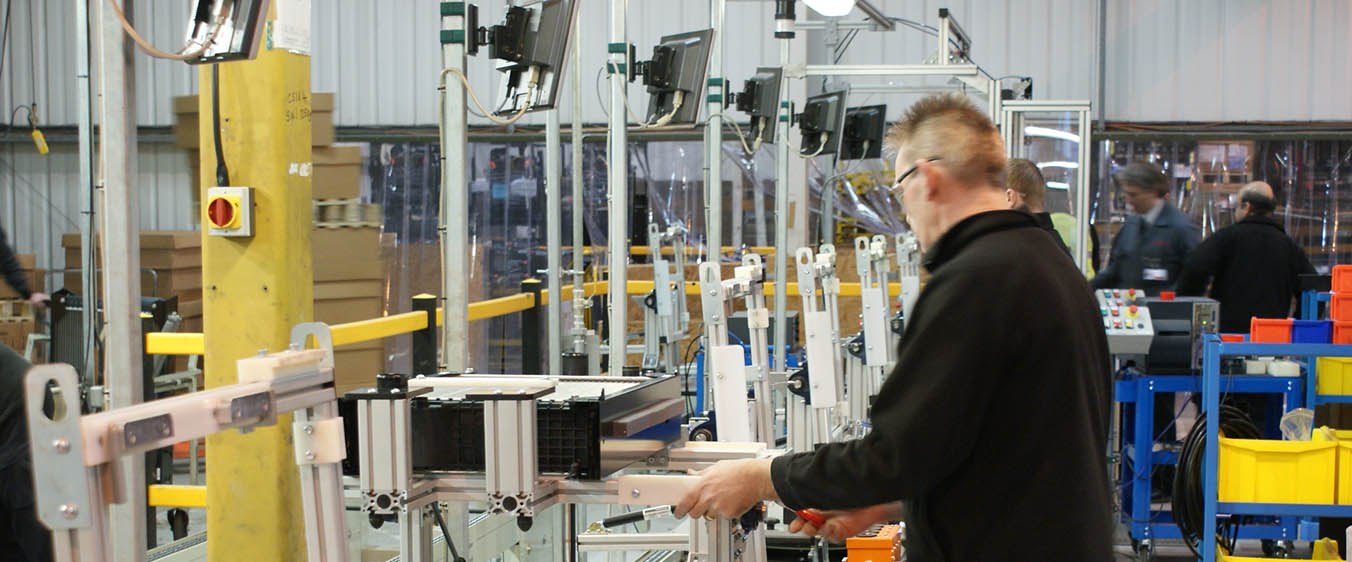
Semi-Automatic Assembly & Testing of Radiators
Client: Leading supplier of advanced automotive technology, systems and components
Part: Automotive Radiators
Machine supplied: Semi-Automatic Assembly and Test Facility
Configuration: Slip Chain Conveyor with 8 Pallets, 4 Manual Assembly Stations, Leak Test Station, Unload Station
TAKT Time: 120 Seconds
Tooling: Interchangeable Pallet Fixtures (Variant-Specific)
Control: 6 PC Screens with Standard Operating Procedures (SOPs), Barcode Verification, Label Generation
The Challenge
A leading automotive technology supplier producing over 100 radiator variants needed a flexible assembly and test facility replacing manual benches. The requirements included:
- Semi-automatic assembly guiding operators through variant-specific sequences
- Accommodation of 100+ different radiator designs without line reconfiguration
- TAKT time of 120 seconds maintaining production throughput
- Intelligent torque control preventing under/over-tightening
- Leak testing as quality assurance before shipment
- Barcode verification ensuring correct parts assembled
- Standard operating procedure (SOP) displays preventing assembly errors
- Interchangeable pallet tooling enabling rapid variant changeover
- Traceability via label generation (batch codes, test results)
Manual benches couldn’t enforce consistent assembly sequences, leading to:
- Incorrect torque application (under-tightened fasteners vibrate loose, over-tightened strip threads)
- Parts mixing (wrong components assembled into radiators)
- Missed assembly steps (forgotten fasteners, missing gaskets)
- Inconsistent leak test application (operators skip testing under time pressure)
- Traceability gaps (no documentation linking assembly to test results)
Radiator failures in the field create:
- Coolant leaks causing engine overheating (breakdown, potential engine damage)
- Cross-contamination between coolant and transmission fluid (transmission failure)
- Warranty claims and customer dissatisfaction
- Recall risks if assembly defects systematic
The facility needed to handle 100+ variants economically without dedicated lines per variant.
The Solution – Semi-Automatic Assembly System
TQC designed a slip chain pallet-based conveyor with 8 pallets circulating through 4 manual assembly stations, leak test station, and unload station. Interchangeable pallet tooling accommodates variant-specific geometries. Electronic torque drivers at each station verify fastener tightening to specification. SOP displays on 6 PC screens guide operators through variant-specific assembly sequences with barcode verification ensuring correct parts. The leak test station uses guarded enclosure with safety interlocks. Intelligent tools log torque data. Label printers generate traceability labels. Live assembly line data displays production status. The system accommodates 100+ part numbers via software-selectable recipes controlling SOP displays, torque specifications, and leak test parameters without physical line reconfiguration.
Technical Overview – Semi-Automatic Assembly System
Slip Chain Pallet-Based Conveyor System
Continuous Loop Material Handling: Slip chain conveyor transports radiators through assembly and test stations:
Conveyor Configuration:
- Forward Path: 8 pallets travelling along front edge past assembly stations, leak test, and unload
- Return Path: Empty pallets return along rear edge to start position
- Loop Time: 8 pallets × 120 seconds TAKT = 16 minutes complete circuit
Slip Chain Technology:
- Chain-driven system with independent pallet movement
- Pallets pushed by chain dogs (engagement points)
- “Slip” function: Pallets stop at stations while chain continues moving
- Automatic pallet release after station operations complete
Why Slip Chain:
- Simple, reliable material transport (fewer mechanical components than indexing systems)
- Flexible station dwell time (pallets wait until operations complete)
- Accumulation capability (pallets queue if downstream station occupied)
- Operator-paced operation (no forced TAKT, operators complete work before release)
Pallet Positions:
- Station 1 (Assembly): Manual operations + torque driver
- Station 2 (Assembly): Manual operations + torque driver
- Station 3 (Assembly): Manual operations + torque driver
- Station 4 (Assembly): Manual operations + torque driver
- Station 5 (Leak Test): Automated pressure test in guarded enclosure
- Station 6 (Unload): Operator removes finished radiator, generates label
- Stations 7-8 (Return): Empty pallets transit to Station 1
Interchangeable Pallet Tooling
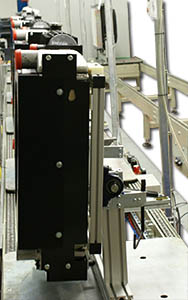
Variant-Specific Fixtures: Each pallet includes removable tooling accommodating radiator geometry:
Pallet Base:
- Standardised steel plate attaching to slip chain dogs
- Precision-machined interface for tooling fixtures
- Pneumatic connections for lift/rotate functions
- Electrical connections for barcode readers and sensors
Interchangeable Tooling Features:
- Part nest (locates radiator core, tanks, brackets)
- Lift mechanism (raises radiator for access to underside fasteners)
- Quick-change mounting (tooling exchanges in minutes using locating pins and clamps)
- Rotate function (tilts radiator for angular access)
- Clamps (secure radiator during assembly operations)
Why Interchangeable Tooling:
- 100+ radiator variants span size range from small passenger cars to heavy-duty trucks
- Dimensions vary: Length 300-800mm, height 200-600mm, depth 20-80mm
- Mounting points differ per vehicle platform
- Single standardised pallet base with variant-specific top tooling eliminates need for 100+ complete pallets
Lift and Rotate Functions:
- Lift: Pneumatic cylinder raises radiator 50-100mm above pallet
- Enables fastener access from below
- Typical application: Bottom tank brackets
- Rotate: Pneumatic actuator tilts radiator 0-45°
- Angular access to side mounting points
- Typical application: Side bracket attachment
Tooling Changeover:
- Remove completed production run radiators
- Release quick-clamps securing current tooling to pallet base
- Lift tooling off pallet (typically 5-20kg weight)
- Position new tooling onto pallet base (locating pins ensure alignment)
- Secure quick-clamps
- Verify pneumatic and electrical connections
- Total changeover: 3-5 minutes per pallet
Four Manual Assembly Stations with Intelligent Tools
Operator-Guided Assembly: Each station includes torque driver, tooling nest, and operator interface:
Station Equipment:
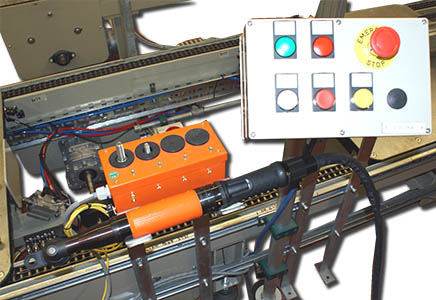
1. Electronic Torque Driver:
- Programmable torque controller (0.5-20 N·m typical automotive fasteners)
- Torque verification: Each fastener tightened to specification ±5%
- Angle control (if specified): Rotation degrees monitored post-torque
- Data logging: Torque, angle, pass/fail per fastener
- Error-proofing: Driver disables if torque not achieved, operator cannot proceed
2. Drive Bit Tooling Nest:
- Organised storage for socket bits, hex bits, Torx bits
- Colour-coded or labelled for rapid identification
- Magnetic holders secure bits when not in use
- Quick-change chuck on torque driver (rapid bit exchange)
3. Operator Interface Panel:
- PC screen (19-24″) displaying current assembly step
- Barcode scanner for part verification
- Indicator lights (green = ready, yellow = in progress, red = error)
- Cycle complete button (operator confirms step done)
Intelligent Tool Benefits:
- Quality Assurance: Every fastener torqued correctly (no under/over-tightening)
- Traceability: Torque data logged per radiator serial number
- Error Prevention: Line stops if torque specification not met
- Process Control: Statistical analysis identifies torque tool drift
Standard Operating Procedure (SOP) Display System
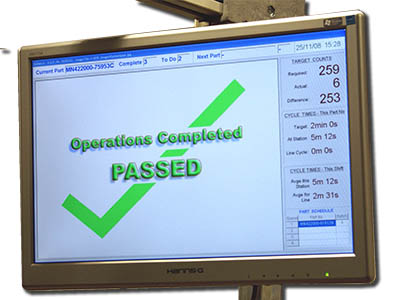
6 PC Screens Guiding Operators: Each assembly station (4) plus leak test and unload stations include display:
SOP Content Per Assembly Step:
- High-resolution image showing current operation
- Text instructions (brief, clear language)
- Parts list with images (verification before installation)
- Torque specification display (real-time during tightening)
- Fastener count (e.g., “4 bolts required”)
- Assembly sequence number (e.g., “Step 3 of 12”)
Variant-Specific SOPs:
- System stores 100+ assembly procedures (one per radiator part number)
- Barcode scan at Station 1 loads correct SOP for scanned radiator
- Each variant’s SOP includes unique:
- Component list and images
- Assembly sequence (step order)
- Torque specifications
- Leak test parameters (pressure, duration, threshold)
SOP Navigation:
- Automatic advance to next step after operator confirmation
- Manual back button (review previous steps if needed)
- Override capability (authorised supervisors only, logged)
Why SOP Displays:
- Error Reduction: Operators cannot skip steps (system enforces sequence)
- Training: New operators learn from visual instructions
- Consistency: Every operator follows identical procedure
- Variant Management: 100+ procedures accessible without printed work instructions
Barcode Verification System
Part and Assembly Traceability:
Barcode Scanning Points:
Station 1 (Initial Scan):
- Operator scans radiator core barcode
- System identifies part number, loads correct SOP
- Verifies radiator scheduled for production
- Logs start time, operator ID (if badge scan implemented)
Each Assembly Station:
- Operator scans component barcodes before installation
- System verifies correct part number for loaded radiator variant
- Error alert if wrong component scanned
- Prevents parts mixing between variants
Unload Station:
- Final scan confirming completed assembly
- Triggers label printer generating traceability label
- Logs completion time, test results, operator stations worked
Error-Proofing Via Barcode:
- Wrong Radiator Core: Scan of incorrect part number rejects radiator, SOP not loaded
- Wrong Components: Scan of incompatible part (e.g., V8 fan shroud on inline-4 radiator) triggers error message, prevents installation
- Skipped Scans: System requires scan confirmation before advancing, operators cannot bypass
Traceability Benefits:
- Warranty claims trace assembly to specific date, operators, component batches
- Recall management identifies affected radiators if component defect discovered
- Process improvement correlates defect rates to specific operators or shifts
Leak Test Station with Guarded Enclosure
Quality Verification Before Shipment:
Leak Test Configuration:
- Radiator on pallet indexes into test station
- Operator closes movable guard (clear polycarbonate panel)
- Guard interlock prevents test if guard open (operator protection from pressure release)
- Automated test sequence executes
Test Procedure:
- Sealing: Pneumatic actuators seal radiator inlets/outlets
- Pressurisation: Air pressure applied (typical 1.5-2 bar, simulates cooling system pressure)
- Stabilisation: 5-10 second pressure equilibrium
- Test Period: 30-60 second pressure decay monitoring
- Pass/Fail Decision: Decay below threshold = pass, excessive decay = fail
- Venting: Controlled depressurisation
- Guard Release: Interlock releases guard after venting complete
Why Guarded Enclosure:
- Safety: Prevents operator access during pressurisation (protects from burst radiators or pneumatic actuator movement)
- Interlock Logic: Guard sensors confirm closure before test starts
- Emergency Stop: Accessible e-stop immediately vents pressure, unlocks guard
Test Parameters Vary by Variant:
- Different radiator designs have different internal volumes
- System adjusts test pressure, time, decay thresholds per variant SOP
- Recipe-driven testing (loaded via barcode scan at Station 1)
Leak Test Data Logging:
- Test pressure
- Pressure decay (ΔP)
- Test duration
- Pass/fail result
- Timestamp
- Radiator serial number
Label Generation and Traceability
Unload Station Functions:
Label Printer:
- Thermal transfer or direct thermal printer
- Prints adhesive label applied to finished radiator
- Label content:
- Radiator part number
- Serial number (unique identifier)
- Production date/shift
- Leak test result (pass/fail, decay value)
- Barcode (2D Datamatrix or QR for automated reading)
Label Application:
- Operator removes radiator from pallet
- Printer automatically generates label (triggered by final barcode scan)
- Operator applies label to designated location on radiator
- Radiator places in packaging for shipment
Traceability Documentation:
- Label data also logs to production database
- Cross-references radiator serial to:
- Component barcodes (which specific parts installed)
- Torque data (every fastener tightening result)
- Leak test result
- Assembly operators (station assignments)
- Production date/time
Live Assembly Line Data Display
Real-Time Production Monitoring:
Data Dashboard:
- Large display screen (32-55″) visible to operators and supervisors
- Real-time metrics:
- Current TAKT time (actual vs. target 120 seconds)
- Units produced (shift, day, week)
- Pass rate (percentage passing leak test)
- Station status (operating, idle, error)
- Active part number (which variant currently assembling)
- Queue status (pallets waiting at each station)
Performance Tracking:
- Hourly production rate
- Downtime tracking (reasons: material shortage, equipment fault, changeover)
- Operator efficiency (compare target vs. actual cycle times)
- Quality trending (leak test failure rate over time)
Benefits:
- Visibility: Operators aware of production targets and progress
- Continuous Improvement: Supervisors identify bottleneck stations
- Problem Response: Real-time alerts enable immediate corrective action
100+ Part Number Configuration
Software-Driven Flexibility:
Recipe Management:
- Each radiator variant stored as recipe in control system
- Recipe contains:
- SOP (assembly images, text instructions, sequence)
- Torque specifications (fastener-specific values)
- Leak test parameters (pressure, time, decay threshold)
- Component barcode list (valid parts for variant)
- Pallet tooling ID (which physical tooling required)
Variant Selection:
- Barcode scan at Station 1 selects active recipe
- System loads variant-specific data to all station displays
- No manual programming or setup required
New Variant Addition:
- Engineering creates new SOP (images, instructions, specifications)
- Uploads recipe to system via network interface
- Fabricates new pallet tooling if geometry incompatible with existing
- System ready for production (no line reconfiguration)
Why Software Configuration:
- 100+ variants impossible with hard-wired systems (limit switches, mechanical stops)
- Software recipes enable unlimited part numbers (constrained only by tooling physical compatibility)
- Recipe changes (specification updates, process improvements) update centrally, deploy to all stations
- Historical recipes archived (enable legacy product support)
System Specifications – Semi-Automatic Assembly System
- Configuration: Slip chain pallet conveyor with 8 pallets
- Stations: 4 manual assembly, 1 leak test, 1 unload, 2 return
- TAKT Time: 120 seconds (target cycle time)
- Pallet Tooling: Interchangeable fixtures with lift and rotate functions
- Assembly Tools: Electronic torque drivers (0.5-20 N·m range)
- Torque Control: Programmable per fastener with data logging
- Operator Guidance: 6 PC screens with SOP displays (images + text instructions)
- Barcode Verification: Part number verification at assembly stations
- Leak Test: Automated pressure decay testing in guarded enclosure (1.5-2 bar)
- Safety: Interlocked guard preventing test with guard open
- Traceability: Label generation with serial numbers, test results, production data
- Live Data: Real-time production monitoring dashboard
- Variant Capacity: 100+ part numbers via software recipes
- Changeover: 3-5 minutes pallet tooling exchange per variant
- Application: Automotive radiators (passenger, commercial, heavy-duty vehicles)
Key Features – Semi-Automatic Assembly System
Pallet-Based Slip Chain Conveyor: 8-pallet continuous loop with independent pallet stops enabling operator-paced assembly.
Interchangeable Tooling: Variant-specific fixtures with lift and rotate functions accommodate 100+ radiator designs.
Intelligent Torque Drivers: Electronic control ensuring every fastener tightened to specification ±5% with data logging.
SOP Display System: 6 PC screens guiding operators through variant-specific assembly sequences with images and text instructions.
Barcode Verification: Part number scanning prevents parts mixing and enables component-level traceability.
Guarded Leak Test Station: Safety-interlocked enclosure protecting operators during automated pressure decay testing.
Label Generation: Automatic traceability labels linking serial numbers to assembly data and test results.
Live Data Dashboard: Real-time production monitoring displaying TAKT time, units produced, pass rates, station status.
100+ Part Number Capability: Software recipe management eliminating line reconfiguration for variant changes.
Rapid Tooling Changeover: 3-5 minute pallet fixture exchange enabling mixed-variant production.
Results
The semi-automatic radiator assembly and test facility provides flexible production for 100+ variants on a single line. Interchangeable pallet tooling accommodates dimensional variation from compact passenger car radiators to heavy-duty truck units without line reconfiguration.
Electronic torque drivers ensure every fastener tightened to specification, eliminating under-torqued joints that vibrate loose and over-torqued threads that strip. Torque data logging provides traceability for warranty analysis and process control.
SOP display systems guide operators through variant-specific assembly sequences with images and text instructions. Barcode verification prevents parts mixing by confirming correct components before installation. The error-proofing eliminates assembly errors that manual benches couldn’t prevent.
Automated leak testing in a guarded enclosure provides 100% quality verification before shipment. Safety interlocks protect operators from pressurisation hazards. Recipe-driven test parameters adjust pressure, time, and thresholds per variant ensuring appropriate testing across the product range.
Label generation creates comprehensive traceability linking radiator serial numbers to component barcodes, torque data, leak test results, assembly operators, and production timestamps. This documentation enables warranty root cause analysis and recall management if component defects discovered.
Live data dashboards provide real-time visibility into production status, TAKT time performance, pass rates, and station utilisation. Supervisors identify bottlenecks and respond to issues immediately rather than discovering problems at shift end.
Software recipe management accommodates 100+ part numbers without physical line changes. New variants add to the system via recipe upload and pallet tooling fabrication. The facility eliminates the capital expense of dedicated assembly lines per variant while maintaining production efficiency and quality.
To view a printer friendly format please click below
Semi Automatic Assembly & Testing of Radiators
Related Capabilities
This project demonstrates TQC‘s expertise in:
- Slip chain pallet conveyor systems
- Interchangeable tooling design
- Electronic torque control and verification
- Standard operating procedure (SOP) display systems
- Barcode traceability integration
- Automated leak testing with safety interlocks
- Multi-variant production flexibility
- Real-time data monitoring dashboards
- Recipe-driven manufacturing systems
- Automotive radiator assembly and testing