

What is Poka-Yoke?
In manufacturing, even a small assembly mistake can lead to rework, production delays or a defective product reaching the customer. Poka-yoke is an engineering principle designed to prevent these errors before they affect product quality.
But what is poka-yoke, and how can manufacturers apply it to their production processes?
This article explains the principle of mistake-proofing, the different methods used in manufacturing and how incorporating poka-yoke into automated assembly systems can improve quality, consistency and efficiency.
What Is Poka-Yoke in Manufacturing?
Poka-yoke is a Japanese term meaning ‘mistake-proofing’. Developed by industrial engineer Shigeo Shingo, the principle focuses on designing manufacturing processes that prevent human errors or detect them immediately before defects move further through production.
Rather than relying entirely on operator training, attention or final inspection, poka-yoke introduces physical controls, sensors or automated checks to reduce the risk of mistakes.
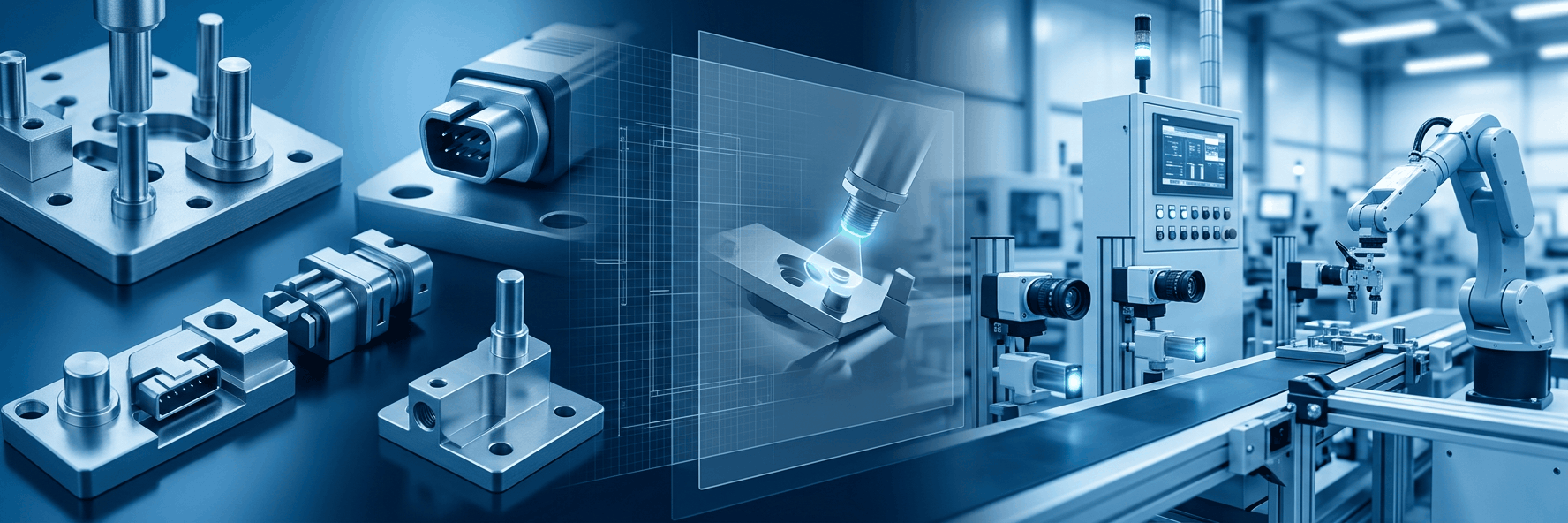
For example, a component fixture might be designed so a part can only be inserted in the correct orientation. Alternatively, sensors could prevent a machine from operating until all required components are present.
Both approaches help manufacturers achieve more consistent assembly quality.
How Does Poka-Yoke Prevent Manufacturing Errors?
There are two main approaches to poka-yoke: prevention and detection.
Prevention-based poka-yoke
Prevention mechanisms stop an error from occurring in the first place.
Examples include:
- Fixtures designed to accept components in only one orientation.
- Locating pins that prevent incorrect assembly.
- Mechanical interlocks that stop operations being performed out of sequence.
These solutions are particularly effective because they reduce dependence on operator judgement or intervention.
Detection-based poka-yoke
Detection mechanisms identify an error when it occurs and trigger a response before the affected product progresses.
Examples include:
- Sensors checking whether components are present.
- Vision systems verifying part orientation.
- Torque monitoring systems identifying incorrect fastening.
- Automated controls stopping production when specified conditions are not met.
Prevention is generally preferable where practical, but detection provides an important alternative when physical mistake-proofing is not possible.
Five Types of Poka-Yoke Implementation in Manufacturing
Different manufacturing processes require different mistake-proofing methods. Five common approaches include:
- Contact or physical poka-yoke
Physical features prevent components from being incorrectly positioned or assembled.
For example, an asymmetrical fixture may only accept a component in its intended orientation.
- Fixed-value poka-yoke
This method verifies that the correct number of components or operations has been completed.
For instance, an automated fastening system can count completed fastening cycles before allowing assembly to continue.
- Motion-step poka-yoke
Motion-step controls ensure manufacturing operations occur in the correct sequence.
A machine might prevent a pressing operation until sensors confirm that the component has been correctly positioned.
- Warning-based poka-yoke
Warning systems use lights, alarms or other signals to alert operators when an abnormal condition is detected.
These systems depend on an appropriate response to prevent defective products progressing.
- Control-based poka-yoke
Control systems automatically stop production or prevent the next operation when a fault is detected.
Unlike warning systems, they do not rely solely on an operator noticing and responding to an alert.
What Are the Benefits of Poka-Yoke in Manufacturing?
Effective poka-yoke implementation in manufacturing can deliver several operational benefits.
Reduced defects and rework: Preventing mistakes at the assembly stage reduces the number of defective components requiring correction or replacement.
Improved production consistency: Built-in controls help ensure manufacturing operations follow the same defined requirements.
Lower inspection costs: Preventing certain errors at source can reduce the need for repeated downstream inspections, although other quality checks may still be necessary.
Improved operator efficiency: Clear guidance and automated checks allow operators to concentrate on production tasks rather than repeatedly checking for common mistakes.
Better quality traceability: Automated systems can record component checks and process results, supporting quality assurance and audit requirements.
These benefits make poka-yoke especially valuable in manufacturing environments where product accuracy, repeatability and reliability are essential.
How Is Poka-Yoke Used in Bespoke Automation?
In automated manufacturing, mistake-proofing can be incorporated directly into the design of assembly and testing equipment.
For example, bespoke automation systems can combine intelligent fixtures, component detection, vision inspection and programmable logic controllers (PLCs) to verify that each operation has been completed correctly.
The most effective approach begins by identifying potential failure points in the manufacturing process. Engineers can then determine whether physical prevention, automated detection or a combination of both provides the most appropriate solution.
Introducing these controls during the initial machine design stage is generally more straightforward than retrofitting them to an established production system.
TQC designs poka-yoke assembly solutions that incorporate mistake-proofing principles into manufacturing equipment, helping businesses improve process control and assembly consistency.
Contact TQC About Poka-Yoke and Bespoke Automation
Understanding what poka-yoke is represents the first step towards building more reliable manufacturing processes.
At TQC, we design and manufacture special purpose machinery that incorporates appropriate mistake-proofing controls, helping businesses reduce assembly errors and improve production efficiency.
Explore our bespoke automation solutions or contact our engineering team to discuss how poka-yoke could improve your manufacturing process.