

Rotary vs. Linear Assembly Machines: How To Choose The Right Architecture
One of the earliest decisions in automated assembly line systems is how parts will move between operations. Two common architectures are rotary indexing systems and linear transfer systems. Both can support assembly, testing and inspection, but they use floor space, tooling and transfer equipment in different ways.
The right choice should follow the process. Part size, cycle time, station count, access, future change and service requirements all influence whether a compact rotary layout or a more modular linear line is the better fit.
How Rotary Systems Work
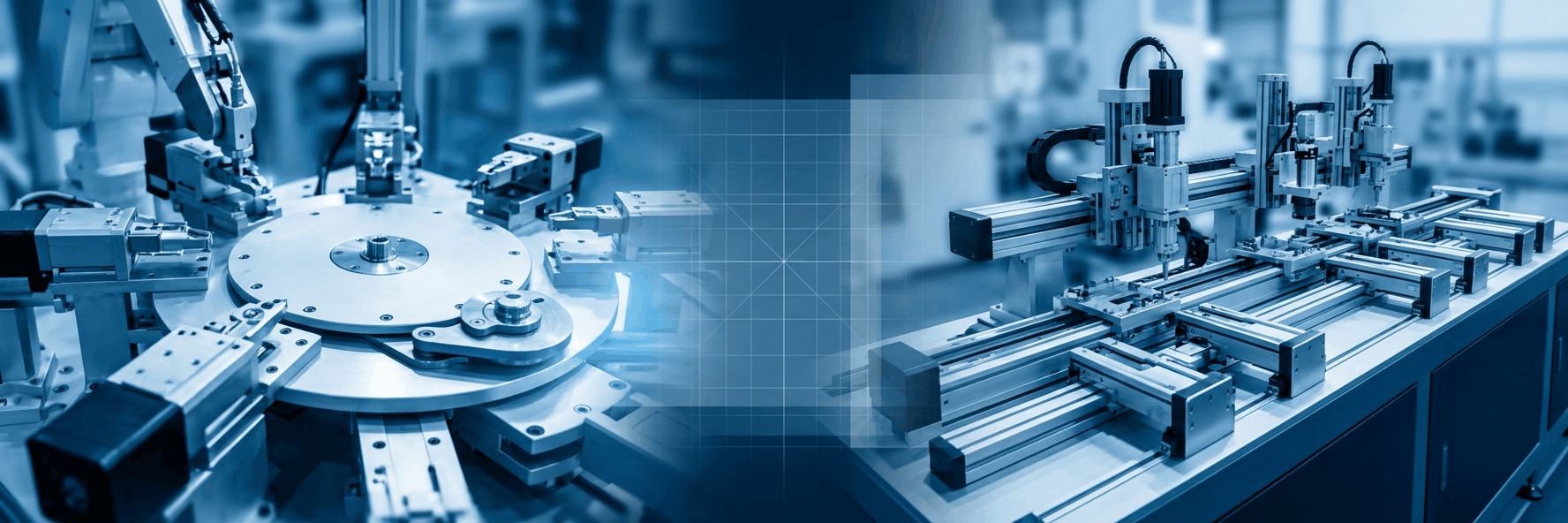
Rotary systems move parts around an indexing table or dial, with fixtures carried from one station to the next. Operations are arranged around the outside of the table and can include feeding, joining, testing, vision inspection and unloading.
The main advantage is a compact machine envelope. A single indexing mechanism can move several fixtures through a repeated sequence without the length of a conveyor-based line. TQC uses rotary systems where the process is well defined and the station arrangement suits a circular layout.
The trade-off is flexibility. Once the table diameter, fixture positions and station layout are fixed, major process changes can require substantial rework. Services that need to travel onto moving tooling can also add complexity.
How Linear Transfer Systems Work
A linear system moves parts or pallets along a straight or looped transfer path. Stations can be positioned along the line as the process requires, with tooling able to access the workpiece from different directions.
This architecture is often easier to expand or reconfigure. If the product gains an extra operation, a new station may be easier to add than it would be on a fixed rotary dial. A pallet transfer system can also support buffering between stations and provide a consistent interface for fixtures moving through the process.
The main disadvantage is footprint. As station count and product size increase, the line gets longer and needs sufficient access for operators and maintenance.
Compare Footprint, Access And Services
Rotary architecture tends to be attractive where floor space is tight and operations can be arranged around the table. Linear architecture gives more freedom over station spacing and access, particularly where tooling needs to operate from both sides or where larger components are involved.
Services such as air, power and data are generally straightforward to route to fixed tooling on either architecture. Where services must move with a carrier, however, the transfer design needs to account for docking, connectors or other interfaces.
Think About Future Change, Not Just Today’s Cycle
A machine that meets the current production requirement can still be a poor investment if it is difficult to adapt to the next variant. Rotary designs are efficient when the sequence is stable. Linear automated assembly line systems are often more forgiving when future stations, buffers or product changes are likely.
Neither architecture is automatically faster. The achievable cycle time depends on the slowest process, transfer time, tooling motion, test duration and the way operations are balanced across stations. Architecture should therefore be selected after the process sequence and timing assumptions are understood. For automated assembly line systems, this timing study also helps show whether operations should run sequentially, in parallel or in separate cells.
A Practical Selection Framework
Consider rotary when you need a compact footprint, the process is stable and all operations fit naturally around a fixed station layout. Consider linear when the station count may change, larger parts need more access, buffering is useful or long-term reconfiguration is a priority.
In some projects, the best answer combines architectures or uses robots to move parts between separate cells. TQC’s automated production lines are designed around the production requirement rather than a preference for one transfer method.
Discuss The Right Line Architecture With TQC
If you are planning a new assembly line and need to compare rotary and linear concepts, TQC can help define the process, cycle time and transfer requirements before the design is fixed. Explore our bespoke automation solutions and speak to the engineering team about your application.