

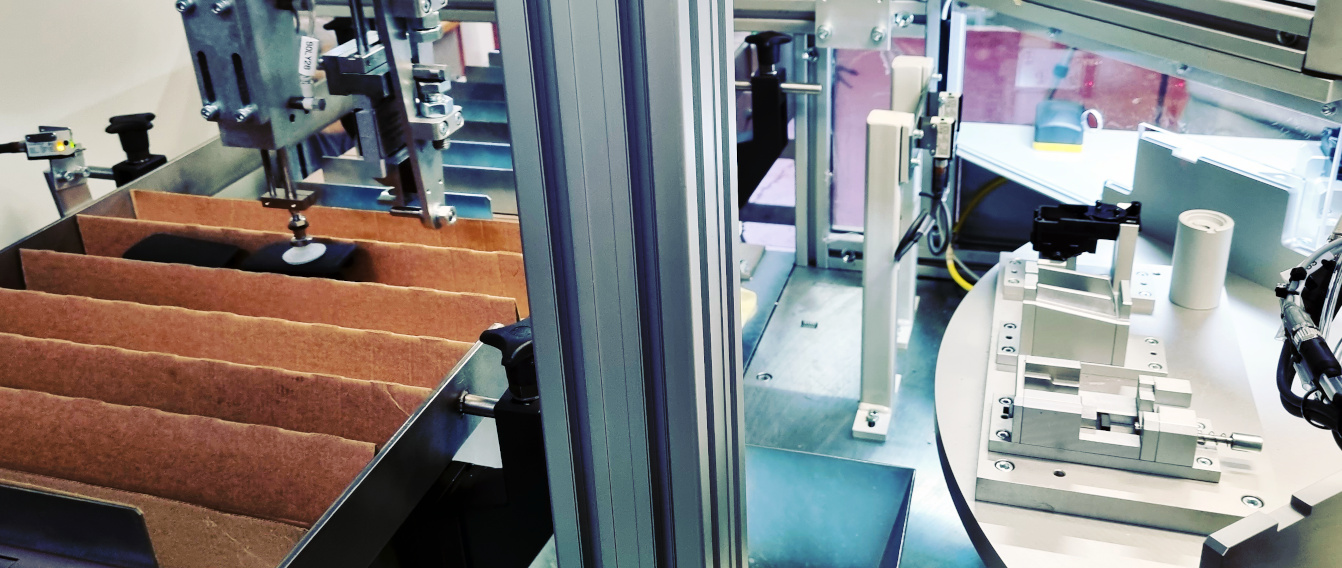
Rotary Table Assembly System for Plastic Parts
Machine supplied: Semi-Automatic rotary table assembly system with testing and automated packing.
Client: Leading Plastic Injection Moulding Company
Part: Automotive Plastic Assembly
Stations: 4-Position Indexing Rotary Table
Operations: Manual Load + Grease Dispense + Vision Assembly Verification + Function Test + Automatic Unload/Pack
Variants: 3 Assembly Types (Including Left/Right Hand Versions)
The Challenge
A leading plastic injection moulding company needed a flexible assembly and test system for automotive plastic mechanisms. The requirements included:
- Assembly of spring-actuated plastic mechanisms requiring precise greasing
- Three assembly variants (including left-hand and right-hand versions) without tooling changes
- Vision verification ensuring correct component fit
- Function testing with force monitoring to validate spring operation
- Automatic segregation of failed assemblies
- Automated packing into cardboard trays for efficient shipment
- Data logging and network integration for quality documentation
Manual assembly couldn’t achieve consistent grease application (critical for spring mechanism operation), and manual function testing lacked the force measurement precision needed to catch weak or missing springs. The system needed to handle variant changes seamlessly while maintaining quality and throughput.
The Solution
TQC designed a 4-station indexing rotary table system combining manual loading with automated grease dispensing, vision verification, function testing, and intelligent unload/packing. The rotary table cycles twice per complete assembly, with operator intervention between cycles to transfer components between nest locations. Vision sensors verify component presence and assembly correctness. Load cell force monitoring validates spring mechanism function. A multi-position pick-and-place system automatically unloads assemblies, segregating rejects while placing passed parts into cardboard tray sleeves on an indexed conveyor for efficient operator packing.
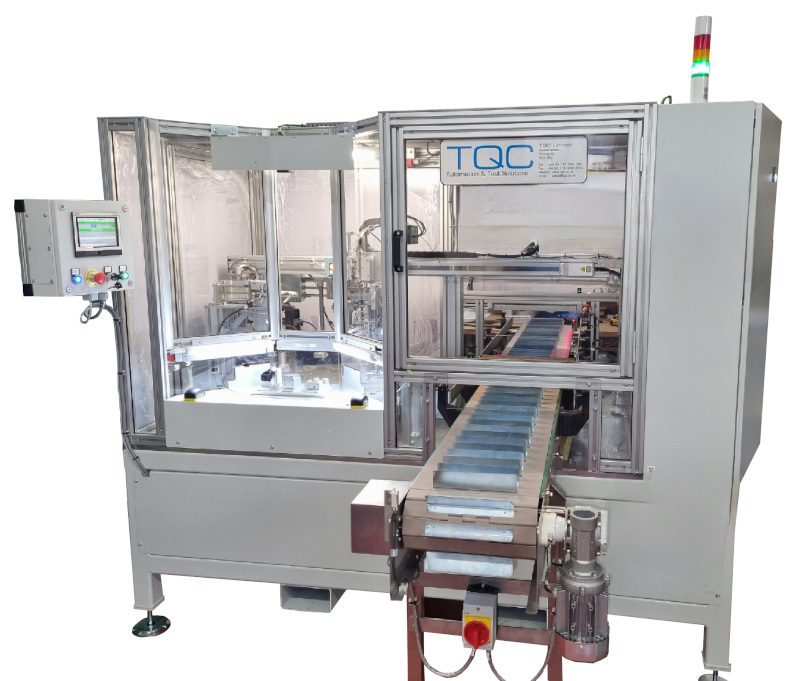
Technical Overview – Rotary Table Assembly System
4-Station Indexing Rotary Table
Rotary Table Architecture: The system uses a precision indexing rotary table with four stations positioned 90° apart:
Station 1 (Load): Operator access station at front of machine
Station 2 (Grease): Automated grease dispensing
Station 3 (Vision): Assembly verification using vision sensors
Station 4 (Test): Function testing with load cell force monitoring
Indexing Operation: After operations complete at each station, the table indexes 90° clockwise, advancing all parts to the next station simultaneously:
- Station 1 → Station 2 (loaded parts advance to greasing)
- Station 2 → Station 3 (greased parts advance to vision verification)
- Station 3 → Station 4 (verified assemblies advance to function testing)
- Station 4 → Station 1 (tested parts return to operator for unload/reload)
Intermittent Motion: The table remains stationary during operations, then indexes rapidly. This intermittent motion provides:
- Stable platform for precision operations (grease dispensing, testing)
- Simple tooling (stationary fixtures at each station)
- No moving hoses or cables (pneumatic and electrical connections made at fixed stations)
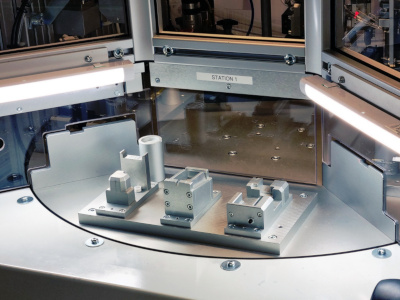
3-Location Nest Tooling
Multi-Location Nests: Each rotary table position includes a nest with three component locations:
Why 3 Locations: The assembly requires multiple plastic components that fit together. The nest design:
- Locates base component in primary position
- Holds secondary components in adjacent positions
- Enables sequential assembly across two table rotations
Operator Workflow (Two-Rotation Sequence):
First Rotation:
- Load Station: Operator loads base components into all three nest locations
- Grease Station: Automated greasing of base components
- Vision Station: Verify base components present and correctly oriented
- Test Station: (Empty during first rotation)
- Return to Load: Operator transfers greased base from primary location, adds secondary components to prepare for assembly
Second Rotation:
- Load Station: Operator loads final assembly components
- Grease Station: Additional greasing if required for secondary components
- Vision Station: Verify all components assembled correctly, check fit and alignment
- Test Station: Function test validates spring mechanism operation
- Automatic Unload: Pick-and-place removes tested assemblies
Why Two Rotations: Complex assemblies require staged operations. Two rotations enable:
- Component preparation (greasing, orientation)
- Sequential assembly steps
- Verification before final testing
Automatic Grease Dispensing (Station 2)
Precision Grease Application: Automated dispensing system applies controlled grease quantity to spring contact areas:
Dispenser Configuration:
- Positive displacement pump for repeatable grease volume
- Heated reservoir maintaining grease viscosity
- Programmable dispense patterns for variant-specific locations
- Nozzle positioning for accurate grease placement
Why Grease Matters: The plastic mechanism includes a spring that must compress and extend smoothly. Grease:
- Reduces friction between spring and plastic housing
- Prevents spring binding or sticking
- Ensures consistent operating force throughout product lifetime
- Protects plastic surfaces from wear
Dispense Verification: Vision system downstream confirms grease presence before assembly proceeds, catching dispenser failures.
Vision Verification (Station 3)
Vision Sensor Array: Multiple vision sensors inspect assemblies:
Inspection Functions:
1. Component Presence: Verify all required plastic parts present in assembly
- Missing components detected before function testing
- Prevents incomplete assemblies from reaching customers
2. Assembly Correctness: Check components fitted together properly
- Snap-fit features fully engaged
- Components aligned and seated
- No gaps or misalignment
3. Orientation Verification: Confirm left-hand vs. right-hand variant assembled correctly
- Asymmetric features identified
- Prevents mixing of variant types in production
4. Grease Verification: Confirm grease applied at required locations
- Detects dispenser failures or skipped parts
- Ensures mechanism will operate smoothly
Vision Technology: Likely LED illumination with industrial cameras running pattern matching algorithms:
- High-contrast lighting reveals part edges and features
- Template matching compares assembly to known-good reference images
- Measurement tools verify critical dimensions
Reject Routing: Assemblies failing vision inspection mark the nest location as “reject.” The function test station bypasses rejects, and automatic unload diverts them to reject bin.
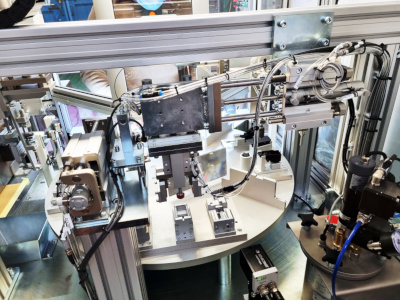
Function Testing with Load Cell (Station 4)
Mechanism Function Validation: Each assembly undergoes functional testing simulating actual operation:
Test Procedure:
- Actuator Engagement: Test actuator engages with spring mechanism
- Compression Stroke: Actuator compresses spring through full operating range
- Force Monitoring: Load cell measures force throughout stroke
- Force Profile Analysis: Measured force compared to specification window:
- Minimum force threshold (ensures spring present and adequate strength)
- Maximum force threshold (detects binding, misassembly, wrong spring)
- Return Stroke: Actuator releases, spring returns mechanism to start position
- Pass/Fail Determination: Force profile within limits = pass; outside limits = fail
Load Cell Integration: Precision load cell in test actuator measures compression force:
- Resolution: Sufficient to detect 5-10% force variation
- Sampling rate: Captures force profile throughout stroke
- Temperature compensation: Maintains accuracy across production environment
Why Force Monitoring: Visual inspection cannot detect:
- Missing or weak springs
- Excessive friction (binding)
- Wrong spring specification
- Internal misalignment
Force measurement validates the assembly will function correctly in the vehicle.
Reject Marking: Failed assemblies mark nest location for automatic segregation at unload station.
Multi-Position Pick-and-Place Unload System
Intelligent Unload Automation: Pick-and-place mechanism handles three destinations:
Pick-and-Place Operation:
- Assembly Extraction: Gripper removes tested assembly from rotary table nest
- Destination Selection: PLC determines routing based on test result:
- Pass + Variant A: Place in cardboard tray position 1
- Pass + Variant B: Place in cardboard tray position 2
- Pass + Variant C: Place in cardboard tray position 3
- Fail (any variant): Divert to reject bin
Multi-Position Capability: Pick-and-place servo-driven with programmable positions:
- Rotary table pickup position
- Three variant-specific tray positions
- Reject bin position
- Positional accuracy ensures consistent placement in tray compartments
Why Variant-Specific Placement: Different assembly variants must not mix. Separate tray positions maintain segregation for downstream handling.
Indexing Outfeed Conveyor with Cardboard Trays
Automated Packing Integration: Outfeed conveyor presents cardboard packing sleeves for automatic part placement:
Conveyor Configuration:
- Indexing motion with flights (dividers) positioning tray sleeves
- Three tray lanes (one per variant)
- Tray presence sensors confirming sleeve ready for parts
- Automatic indexing when tray fills
Packing Sequence:
- Operator loads empty cardboard sleeve onto conveyor flight
- Pick-and-place fills tray with passed assemblies (one variant per tray)
- When tray fills (programmed count), conveyor indexes to next flight
- Operator removes filled tray, loads empty sleeve
- Process continues
Efficiency Advantage: Automatic packing eliminates manual sorting and placement. Operator focuses on tray loading/unloading rather than assembly handling, increasing throughput.
Multi-Variant Handling – Rotary Table Assembly System
Three Variants Without Changeover: System accommodates three assembly types simultaneously:
Variant Handling Strategy:
- Operator Selection: Operator identifies variant at load station (manual selection via HMI or automatic via barcode scan)
- PLC Tracking: System tracks which variant occupies each rotary table position
- Variant-Specific Operations:
- Grease dispense pattern adjusts per variant
- Vision inspection uses variant-specific templates
- Function test force limits adapt to variant specifications
- Unload routing directs to variant-specific tray position
Left-Hand/Right-Hand Versions: One variant includes mirror-image versions:
- Vision system distinguishes orientation
- Same grease pattern and function test (symmetrical operation)
- Separate tray positions prevent mixing
Changeover-Free Production: Operators can load any variant at any time. The system automatically adapts, enabling mixed production runs without downtime.
PLC Control with Data Logging
Programmable Logic Controller (PLC): Manages all automation and data collection:
Control Functions:
- Rotary table indexing timing
- Grease dispenser actuation and volume
- Vision system trigger and result processing
- Function test sequencing and force measurement
- Pick-and-place positioning and grip control
- Conveyor indexing
Operator HMI (Human-Machine Interface):
- Touchscreen displaying cycle status and instructions
- Variant selection
- Production count by variant (passed, failed)
- Reject rate trending
- Alarm messages and fault diagnostics
Operator Buttons: Physical buttons for:
- Cycle start
- Emergency stop
- Manual jog functions for setup/recovery
Data Logging: System records for each assembly:
- Variant type
- Vision inspection results (pass/fail by criterion)
- Function test force profile
- Pass/fail result
- Date/time stamp
- Operator ID (if login system implemented)
Network Integration: Logged data automatically transfers to customer PC network:
- Real-time quality monitoring
- Statistical process control
- Traceability documentation
- Production reporting
System Specifications – Rotary Table Assembly System
- Configuration: 4-station indexing rotary table
- Stations: Load (manual), grease (auto), vision (auto), function test (auto)
- Nest Design: 3-location per position for staged assembly
- Cycle Sequence: 2 rotations per complete assembly with operator intervention between
- Grease Dispensing: Automated with positive displacement pump
- Vision Inspection: Multiple sensors verifying presence, assembly, orientation, grease
- Function Testing: Load cell force monitoring through compression/return stroke
- Unload: Multi-position pick-and-place with variant-specific routing
- Packing: Indexing conveyor with cardboard tray sleeves (3 variant lanes)
- Variants: 3 assembly types (including left/right hand) without changeover
- Control: PLC with operator HMI and manual buttons
- Data: Automatic logging and network transfer
- Application: Automotive plastic spring mechanisms
Key Features – Rotary Table Assembly System
4-Station Rotary Indexing: Simultaneous operations at each station maximise efficiency while maintaining quality.
Two-Rotation Assembly: Staged operations enable complex assembly without excessive station count.
Automatic Grease Dispensing: Precision application ensures consistent spring mechanism operation throughout product life.
Vision Verification: Multi-sensor inspection catches missing components, misassembly, and grease failures before functional testing.
Load Cell Function Test: Force profile monitoring validates spring presence, strength, and freedom of movement.
Multi-Position Pick-and-Place: Intelligent unload routes passed assemblies to variant-specific trays, diverts rejects to bin.
Automated Packing: Indexing conveyor with tray sleeves reduces operator handling and maintains variant segregation.
Multi-Variant Flexibility: Three assembly types handled simultaneously without changeover downtime.
Data Logging and Network Integration: Comprehensive quality documentation with automatic transfer to customer systems.
Results – Rotary Table Assembly System
The rotary table assembly and test system provides flexible automation for automotive plastic spring mechanisms. The 4-station configuration with two-rotation sequencing enables complex assembly while maintaining throughput.
Automatic grease dispensing eliminates manual application variability, ensuring consistent spring mechanism performance. Vision verification catches assembly errors before expensive function testing, reducing scrap.
Load cell force monitoring provides quantitative validation of spring operation, detecting weak springs, binding, or internal misalignment that visual inspection cannot identify. The precision force measurement ensures mechanisms will operate reliably throughout vehicle lifetime.
Multi-position pick-and-place with variant-specific tray routing automates packing while maintaining segregation. The indexing conveyor reduces operator handling and simplifies packaging workflow.
Multi-variant capability without changeover enables mixed production runs, improving scheduling flexibility and reducing inventory. Data logging with network integration provides comprehensive quality documentation and enables real-time process monitoring.
To view a printer friendly format please click below
Rotary Table Assembly System for Plastic Parts
Related Capabilities
This project demonstrates TQC‘s expertise in:
- Rotary indexing table systems
- Multi-station automated assembly
- Precision grease dispensing
- Vision inspection systems
- Load cell force monitoring
- Function testing automation
- Multi-position pick-and-place
- Automated packing systems
- Multi-variant production without changeover
- PLC control with data logging
- Network integration for quality systems
- Automotive plastic assembly
If you have an application that could benefit from TQC‘s expertise in automatic assembly or automated testing, and the design and manufacture of rotary table assembly systems, please contact us by email or phone via the contact details, please contact us by email or phone via the contact details