

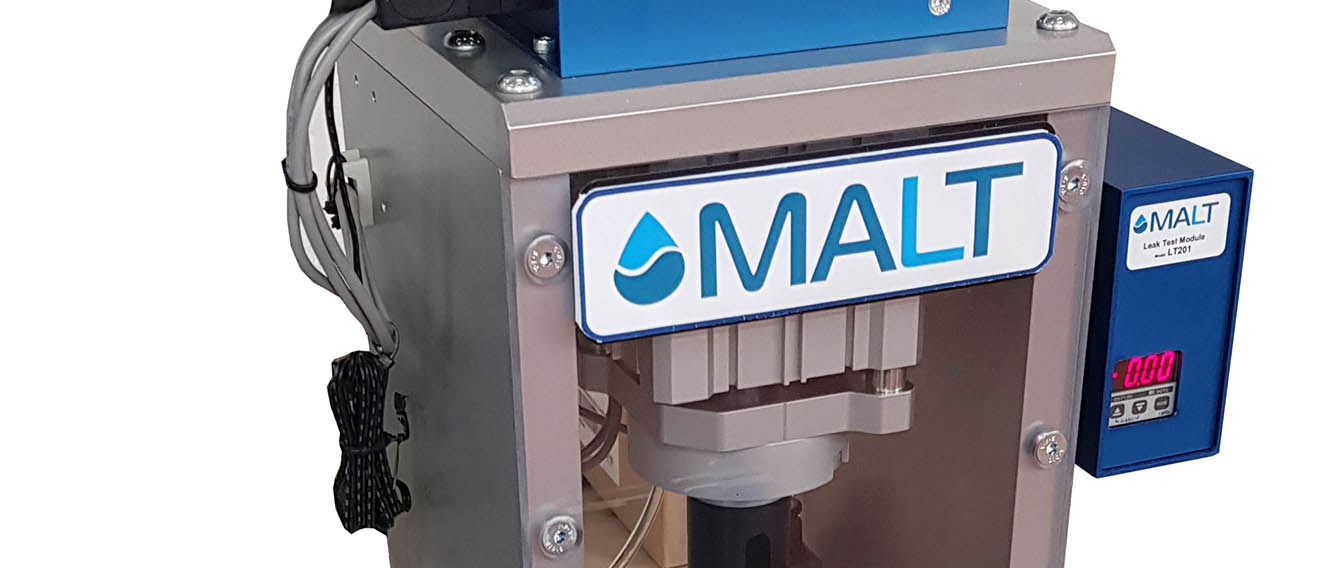
Leak Test Drawer Fixture
Machine supplied: Drawer Leak test fixture
Client: Leading Plastic Moulding Company
Part: Automotive Oil Level Sensor Cable
Test Method: Pressure Decay (Air)
Test Pressure: Up to 3 bar (expandable to 20 bar via pressure rise from vacuum)
The Challenge
A leading plastic moulding company needed production leak testing for automotive oil level sensor cables. The test requirements included:
- 100% inspection to verify cable seal integrity
- Detection of leak paths that would allow oil migration along the cable
- Manual load/unload suitable for medium-volume production
- Operator-friendly interface with minimal training requirements
- Automatic drawer lock on failures to prevent defective parts leaving the station
- Compact benchtop footprint for production floor integration
Oil level sensor cables must maintain hermetic sealing at the cable entry point. Any leak path allows engine oil to migrate along the cable interior, potentially reaching electrical connections and causing sensor failure or contamination of engine management systems.
The Solution
TQC designed a Series 20 drawer fixture with MALT (Multi-Application Leak Tester) instrumentation. The drawer mechanism provides safe manual loading outside the test chamber while automatic closure and sealing enable pressure decay testing. Custom polyurethane seals accommodate the cable geometry, and the MALT controller integrates directly with drawer switches and interlocks, eliminating the need for a separate PLC
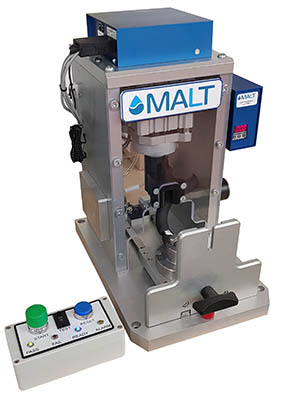
Technical Overview – Drawer Leak test fixture
Series 20 Drawer Fixture Architecture
The fixture is based on TQC‘s Series 20 standard platform for small to medium components:
Benchtop Configuration: Compact design suitable for production workbenches. The fixture positions the drawer at ergonomic working height for operators.
Drawer Mechanism: A sliding drawer carries the bottom tooling nest. The operator loads the cable assembly with the drawer in the extended (load) position. Pushing the drawer forward moves the part into the test chamber behind a Perspex guard.
Two-Position Operation:
- Load/Unload Position: Drawer extended, operator access to tooling nest
- Test Position: Drawer closed, part sealed in chamber for pressure testing
Perspex Guard: Transparent guarding provides operator visibility during testing while maintaining safety compliance. The guard prevents access to the pressurised chamber.
Custom Tooling for Cable Geometry
Bottom Tooling: The nest in the drawer locates the cable assembly and provides support during pressurisation. The tooling includes passages that connect the cable interior to the MALT pressure source.
Top Sealing Tooling: Mounted on a compact pneumatic cylinder behind the Perspex guard, the top tooling lowers onto the cable when the drawer closes. Custom polyurethane seals create a leak-tight connection around the cable entry point.
Polyurethane Seal Design: TQC designed custom polyurethane seals to accommodate the cable’s irregular geometry. Polyurethane provides:
- Flexibility to conform to part variations
- Durability for repeated sealing cycles
- Chemical resistance to oils and cleaning agents
- Long service life in production environments
Interchangeable Tooling: The tooling is designed for easy replacement. If product variants require different cable geometries, new tooling sets can be installed without modifying the fixture, providing future-proof flexibility.
MALT Leak Test Instrumentation
OEM MALT LT201: The system uses a MALT (Multi-Application Leak Tester) valve module and controller configured for pressure decay testing:
Valve Module Placement: The valve module mounts close to the fixture tooling, minimizing the test volume. Smaller test volumes improve sensitivity and reduce test time by eliminating dead volume in long pneumatic lines.
Pressure Decay Method: The MALT pressurizes the cable interior to the test pressure, holds for stabilization, then monitors pressure decay over the test period. Leak paths in the cable seal allow air escape, causing measurable pressure drop.
Integrated Control: The MALT controller includes digital I/O (inputs/outputs) that connect directly to drawer switches and interlocks, eliminating the need for a separate PLC. This simplifies the system architecture and reduces cost.
Controller Functions:
- Test sequence automation (fill, stabilize, test, vent)
- Pressure monitoring and leak rate calculation
- Pass/fail determination based on programmable criteria
- Drawer lock control based on test result
- Integration with operator button box
Operator Interface
Button Box: An operator button box on a flying lead allows positioning to the right or left of the drawer, accommodating both right-handed and left-handed operators.
Controls:
- Green start button: Initiates test (alternative to drawer closure trigger)
- Pass/fail indicator lights
- Emergency stop button
Test Initiation Options:
- Automatic: Closing the drawer triggers the test sequence
- Manual: Operator presses green start button after drawer closure
Drawer Interlock: Switches in the drawer detect closure and communicate with the MALT controller. The system verifies the drawer is properly closed before pressurisation begins.
Safety Features
Automatic Drawer Lock on Failure: The MALT controller is configured to lock the drawer in the closed position when a part fails the leak test. This prevents the operator from removing the defective part until they acknowledge the failure, ensuring rejects are properly segregated.
Drawer Lock Release: After failure acknowledgment, the operator can open the drawer to remove the rejected part. This feature prevents defective parts from inadvertently entering production.
Pressure Interlocks: The system verifies the drawer is closed before pressurization. If the drawer opens during testing (e.g., emergency stop), the system immediately vents.
Optional Enhancements
Pass Stamping: A marking system can be integrated to stamp passed parts with identification, providing visual confirmation of test completion.
Label Printing: The MALT can trigger a label printer on pass results, printing traceability labels with test data, date/time stamps, and serial numbers.
High-Pressure Testing: For applications requiring pressures above the MALT’s 3 bar limit, TQC can implement pressure rise from vacuum methodology. The part is pressurised to high pressure (up to 20 bar) while a small test volume around the seal is evacuated. Any leak allows pressure rise in the evacuated volume, enabling high-pressure testing with the MALT’s low-pressure transducers.
Test Sequence – Drawer Leak Test Fixture
1. Cable Loading: Operator places cable assembly in bottom tooling nest with drawer in extended position.
2. Drawer Closure: Operator pushes drawer forward to test position. Drawer engages mechanical stops and triggers closure switches.
3. Top Tooling Engagement: Pneumatic cylinder lowers top sealing tooling onto cable, compressing custom polyurethane seals.
4. Test Initiation: Test starts automatically on drawer closure, or operator presses green button.
5. Pressurisation: MALT pressurizes cable interior to test pressure through tooling passages.
6. Stabilisation: Pressure stabilizes while system reaches thermal equilibrium.
7. Test Phase: MALT monitors pressure decay over test period. Leak rate is calculated and compared to acceptance criteria.
8. Pass/Fail Indication: Button box lights indicate result (green for pass, red for fail).
9. Drawer Response:
- Pass: Drawer unlocks automatically, operator pulls drawer to load position and removes tested cable
- Fail: Drawer remains locked, operator must acknowledge failure before drawer unlocks
10. Venting: System vents pressure before drawer can open.
11. Ready for Next Part: System ready for next cable loading.
System Specifications – Drawer Leak Test Fixture
- Fixture Type: Series 20 drawer style with manual load/unload
- Test Instrument: MALT OEM LT201 valve module and controller
- Test Method: Pressure decay (air)
- Test Pressure Range: Up to 3 bar standard (expandable to 20 bar via pressure rise from vacuum)
- Drawer Positions: Load/unload (extended) and test (closed)
- Tooling: Custom bottom nest and top sealing with polyurethane seals
- Tooling: Interchangeable for future part variants
- Operator Interface: Button box on flying lead (left/right positioning)
- Test Initiation: Automatic (drawer closure) or manual (button press)
- Safety Feature: Automatic drawer lock on failed parts
- Control: MALT controller with integrated I/O (no separate PLC required)
- Footprint: Benchtop (compact production environment suitable)
- Application: Automotive oil level sensor cables
Key Features – Drawer Leak Test Fixture
Series 20 Platform: Proven drawer fixture design suitable for small to medium components with manual operation.
MALT Integration: Simple architecture with MALT controller managing drawer interlocks and test sequencing without separate PLC.
Custom Polyurethane Seals: Accommodate irregular cable geometry with flexible, durable sealing for repeated cycles.
Interchangeable Tooling: Future-proof design allows new tooling for product variants without fixture modification.
Automatic Drawer Lock: Failed parts remain in locked drawer until operator acknowledgment, preventing defective parts from entering production.
Ambidextrous Operation: Button box on flying lead positions for left or right-handed operators.
Dual Test Initiation: Automatic (drawer closure) or manual (button press) start options.
Compact Benchtop: Minimal footprint for production floor integration.
Results
The Series 20 drawer fixture with MALT instrumentation provides 100% inspection of automotive oil level sensor cables. Pressure decay testing verifies cable seal integrity, preventing oil migration that could cause sensor failure.
Custom polyurethane seals accommodate the cable geometry while providing repeatable sealing over thousands of test cycles. The interchangeable tooling design protects the investment by allowing future product variants without fixture replacement.
Automatic drawer locking on failures ensures defective parts are identified and segregated before entering production. The simple MALT integration eliminates PLC requirements, reducing system complexity and cost while maintaining full test automation.
TQC has in the past also integrated a 20 bar high pressure test into similar systems. The MALT has a 3 bar maximum test pressure but by careful arrangement of the test volume a pressure rise technique from vacuum can be used whilst still pressurising the part to high pressure.
To view a printer friendly format please click below
If you have an application that could benefit from TQC’s expertise in leak testing, please contact us on by email or phone via the contact details