

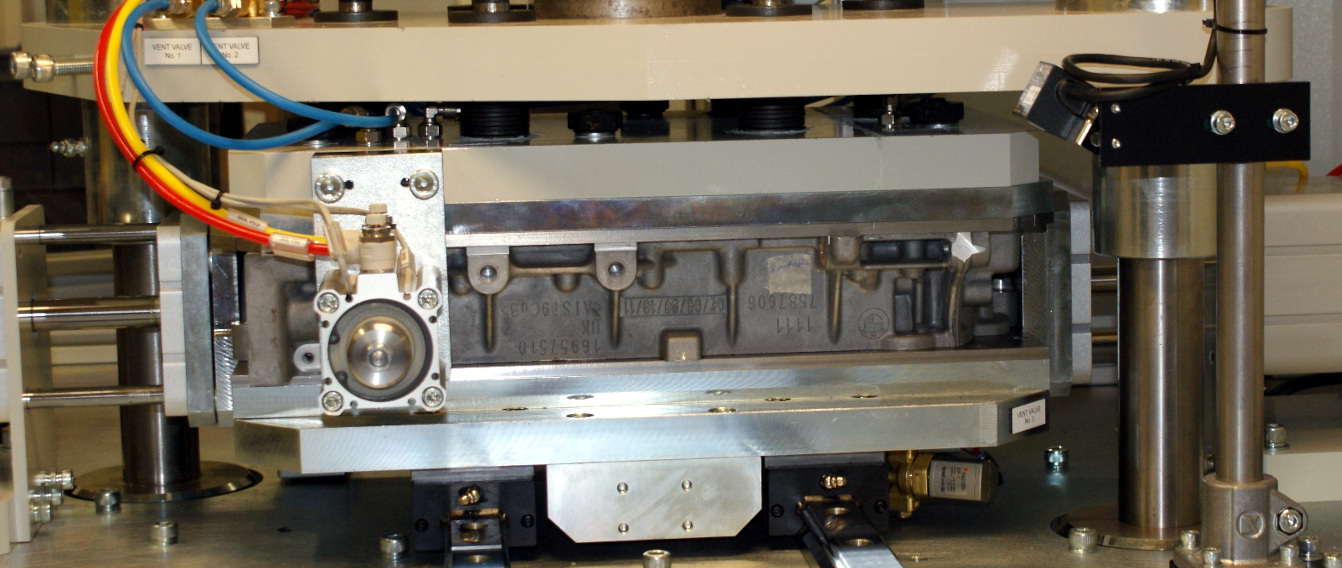
Leak Test Solution for Automotive Bedplates
Machine supplied: Standard Series 40 based leak test solution for automotive bedplate castings
Client: Leading Automotive Aluminium Die Casting Company
Part: Automotive Engine Bedplate (Aluminium Die Casting)
Test Method: Pressure Decay (Leak Test + Blockage Test)
Configuration: Two-Position Transfer Carriage with Automatic Sealing
The Challenge
A leading automotive aluminium die casting company needed production leak testing for engine bedplate castings. The test requirements included:
- Detection of porosity in aluminium die castings (inherent to casting process)
- Verification of core passage integrity (oil galleries, coolant channels)
- Blockage testing to confirm all internal passages are clear
- Multiple port sealing (bedplates have numerous oil and coolant connections)
- Barcode traceability linking test results to individual castings
- Automatic pass marking for visual confirmation of tested parts
- Integration with casting production line throughput
Engine bedplates are structural castings that support the crankshaft and house critical oil and coolant passages. Porosity in the casting walls or blockage in internal passages can cause:
- Oil leakage leading to lubrication failure
- Coolant leakage causing overheating
- Cross-contamination between oil and coolant systems
- Engine seizure or catastrophic failure
The complex internal geometry with multiple interconnected passages requires both leak testing (external seal integrity) and blockage testing (internal flow paths).
The Solution
TQC designed a Series 40-based leak test system with automatic multi-port sealing and integrated blockage testing. A two-position transfer carriage allows safe manual loading outside the test area while automated sealing, testing, and marking occur at the test position. Part infills reduce test volume to increase sensitivity. The system automatically scans 2D barcodes for traceability, performs leak and blockage tests sequentially, and percussion marks passed parts before operator unloading.


Technical Overview
Series 40 Platform Architecture
Proven Standard Design: The system is based on TQC‘s Series 40 platform, a cost-effective standard leak test solution that accommodates various test instruments and part configurations.
Series 40 Benefits:
- Field-proven reliability across numerous automotive applications
- Standard framework reduces engineering time and cost
- Modular design allows customization for specific parts
- Integral PLC control eliminates external controller requirements
- Compact footprint for production floor integration
Framework Construction: Fabricated painted steel framework with aluminium extrusion guarding provides rigid support while maintaining operator visibility and access.
Two-Position Transfer Carriage
Dual-Position Operation: The leak test solution uses a transfer carriage that moves between two positions:
Position 1 (Load/Unload): Located at the front of the machine behind a light guard. The operator:
- Loads bedplate casting into tooling
- Bedplate barcode faces 2D scanner
- Initiates cycle
- Unloads marked part after testing completes
Position 2 (Test): Located inside the machine test area. Automated operations occur here:
- Barcode scanning
- Sealing system engagement
- Leak and blockage testing
- Pass marking
Carriage Transfer: Pneumatic actuation moves the carriage between positions. Position sensors verify carriage location before test sequences begin.
Safety Advantage: Manual loading occurs outside the test area, preventing operator exposure to moving sealing mechanisms or pneumatic clamping forces. The light guard at the load/unload position provides additional safety.
Bespoke Location Tooling with Part Infills
Location Tooling: Custom-designed tooling locates the bedplate casting precisely:
- Datum surfaces establish repeatable positioning
- Support structure prevents deflection during clamping and pressurization
- Quick-release features enable tooling changes for bedplate variants
Part Infills – Test Volume Reduction: TQC designed infill blocks that fit into the bedplate’s internal cavities:
Why Infills Matter: The bedplate has large open volumes (crankshaft cavities, bearing supports). Without infills, these volumes become part of the test volume, which:
- Increases test time (larger volume takes longer to pressurize and stabilize)
- Reduces sensitivity (leaks produce smaller pressure changes in larger volumes)
- Requires more test gas
Infill Design: Precision-machined blocks fill non-critical volumes while leaving oil and coolant passages open for testing. The infills include:
- Seals that isolate filled cavities from test volumes
- Clearance for passages that must remain open
- Quick-change design for bedplate variant changes
Sensitivity Improvement: Reducing test volume by 70-80% (typical with infills) proportionally increases leak detection sensitivity, enabling detection of smaller casting porosity.
Automatic Multi-Port Sealing System
Sealing Challenge: Engine bedplates have numerous ports for oil supply, oil return, coolant inlet, coolant outlet, and bolt holes. Each port requires sealing for leak testing.
Multiple Seal Units: The automatic sealing system includes individual seal units for each port:
Seal Unit Design: Each unit consists of:
- Seal adapter matched to port geometry (thread seal, face seal, or compression seal)
- Pneumatic actuator to engage seal
- Pressure connection to test instrumentation
- Position sensor verifying seal engagement
Automatic Engagement: When the carriage reaches the test position:
- Pneumatic clamping holds the bedplate firmly in tooling
- Multiple seal units advance simultaneously
- Each unit engages its corresponding port
- Position sensors verify all seals are seated
- System proceeds to testing only if all seals confirm engagement
Seal Variety: Different ports require different seal types:
- Threaded Ports: Threaded adapters screw into port
- Face Seal Ports: O-rings compressed against machined faces
- Open Cavities: Compression seals or gasket seals
Dual Testing: Leak Test and Blockage Test
Sequential Test Methodology: The leak test solution performs two distinct tests:
Leak Test (Pressure Decay)
Purpose: Detect porosity in casting walls and verify seal integrity at all ports.
Method:
- Oil and coolant passages are pressurized with air
- Pressure stabilizes
- System monitors pressure decay over test period
- Excessive decay indicates porosity or seal leaks
Test Pressure: Specific to bedplate design (typically 2-5 bar for oil circuits, 1-3 bar for coolant circuits)
Pass Criteria: Pressure decay must remain below specified threshold
Blockage Test (Flow Verification)
Purpose: Confirm that all internal passages are clear and coolant/oil can flow properly.
Method:
- Air flows through specific passage routes
- Flow meters measure actual flow rate
- Flow readings compare to specification
- Low flow indicates blockage from casting cores, debris, or incomplete machining
Why Blockage Testing Matters: Die casting cores create internal passages. If cores break, shift, or don’t fully remove during post-casting cleaning, passages can be partially or completely blocked. Blockages prevent proper lubrication or cooling, causing engine failure even if the casting has no porosity.
Test Sequence: Blockage testing typically follows leak testing. Only parts that pass leak testing proceed to blockage testing, saving test time.
2D Barcode Scanning for Traceability
Automatic Barcode Reading: A 2D barcode scanner reads the Data Matrix or QR code marked on each bedplate casting:
Barcode Content:
- Casting serial number
- Batch/lot code
- Casting date
- Part variant identifier
Traceability Integration: The PLC links test results to the scanned barcode:
- Test pressure values
- Leak rate measurements
- Blockage test flow rates
- Pass/fail result
- Test date/time
Data Storage: Test data exports to customer quality systems, enabling:
- Individual casting traceability throughout vehicle lifetime
- Process trend analysis (identifying drift in casting quality)
- Root cause analysis if field failures occur
Multi-Position Pass Marking
Percussion Marker: An electromagnetic percussion marker creates permanent pass marks on the bedplate:
Multi-Position Capability: The marker indexes to multiple locations on the bedplate, marking:
- Main casting surface (primary pass mark)
- Secondary location (backup verification)
- Date code or inspector ID
Why Multi-Position: Multiple marks ensure at least one remains visible after machining, coating, or assembly operations that may obscure individual marks.
Permanent Marking: Percussion marks are embossed into the aluminium, creating permanent identification that survives harsh engine environments.
Furness Controls FC0750 Leak Test Instrument
Integrated Test Instrument: The system includes a Furness Controls FC0750 leak test instrument:
Instrument Capabilities:
- High-resolution pressure transducers
- Multi-channel capability (leak test and blockage test)
- Programmable test sequences
- Leak rate calculation and comparison to limits
- Pass/fail determination
Built-In Configuration: The FC0750 mounts within the Series 40 framework, eliminating external instrument cabinets and simplifying pneumatic connections.
PLC Control with Colour Touchscreen HMI
PLC Control System: Programmable logic controller manages all automation:
- Carriage position control
- Seal engagement sequencing
- Test instrument communication
- Barcode scanner interface
- Percussion marker control
- Light guard safety interlocks
Colour Touchscreen HMI: Operator interface provides:
Graphical Instructions: Screen displays visual step-by-step guidance:
- Part orientation in tooling (3D graphics)
- Loading procedure
- Test progress indicators
- Pass/fail result with visual indicators
Production Monitoring:
- Real-time test pressure and flow displays
- Cycle count (parts tested, passed, failed)
- Reject rate trending
- Test time monitoring
Parameter Access: Authorized users can adjust:
- Test pressures for different bedplate variants
- Pass/fail thresholds
- Test sequence timing
System Specifications – Leak Test Solution
- Platform: Series 40 standard leak test solution
- Test Types: Leak test (pressure decay) + blockage test (flow verification)
- Carriage Positions: 2 (load/unload and test)
- Loading: Manual via light guard at load/unload position
- Location Tooling: Bespoke for bedplate geometry
- Test Volume Reduction: Part infills for increased sensitivity
- Sealing: Automatic multi-port sealing system (multiple seal units)
- Clamping: Hydra-Pneumatic
- Traceability: Automatic 2D barcode scanning
- Marking: Multi-position percussion marker for passed parts
- Test Instrument: Furness Controls FC0750 (built-in)
- Control: PLC with colour touchscreen HMI
- Safety: Light guard access at load/unload position
- Framework: Fabricated painted steel with aluminium extrusion guarding
- Application: Automotive engine bedplate castings (aluminium die cast)
Key Features – Leak Test Solution
Series 40 Standard Platform: Proven, cost-effective design with integral PLC control and flexible configuration.
Two-Position Carriage: Safe manual loading outside test area with automated sealing and testing at test position.
Part Infills: Reduce test volume 70-80%, increasing leak detection sensitivity for casting porosity.
Automatic Multi-Port Sealing: Individual seal units for each port engage simultaneously with verification.
Dual Testing: Sequential leak test and blockage test ensure both seal integrity and passage clarity.
2D Barcode Traceability: Automatic scanning links test results to individual castings for lifetime traceability.
Multi-Position Pass Marking: Permanent percussion marks at multiple locations survive post-test operations.
Integrated FC0750 Instrument: Built-in Furness Controls leak tester eliminates external cabinets.
Graphical HMI: Colour touchscreen with visual instructions guides operators through loading and testing.
Results – Leak Test Solution
The Series 40-based bedplate leak test system provides comprehensive quality verification for automotive engine bedplate castings. Part infills increase leak detection sensitivity by reducing test volume, enabling detection of porosity as small as 0.1mm in critical casting walls.
Automatic multi-port sealing eliminates manual seal handling, reducing operator variability and improving test repeatability. Sequential leak testing and blockage testing verify both external seal integrity and internal passage flow, catching both casting porosity and core-related blockages.
2D barcode integration provides full traceability from casting through engine assembly. Test data linked to individual castings enables process trend analysis and root cause investigation if field failures occur.
Multi-position percussion marking ensures passed parts remain identifiable through machining, coating, and assembly operations. The two-position carriage maintains production throughput while protecting operators from moving automation during the test cycle.
To view a printer friendly format please click below
Automotive Bedplate Leak Test Solution
Related Capabilities
This project demonstrates TQC‘s expertise in:
- Series 40 standard leak test platform
- Aluminium die casting leak testing
- Multi-port automatic sealing systems
- Part infill design for test volume reduction
- Blockage testing (flow verification)
- Two-position transfer carriage systems
- 2D barcode scanning and traceability
- Multi-position percussion marking
- Furness Controls instrument integration
- Graphical HMI operator interfaces
- Automotive casting production environments
For more examples of Series 40 and other styles of leak test solutions visit our other pages, all our standard systems can be configured for either over-pressure, vacuum, or dosing applications dependent on your leak testing requirements.